
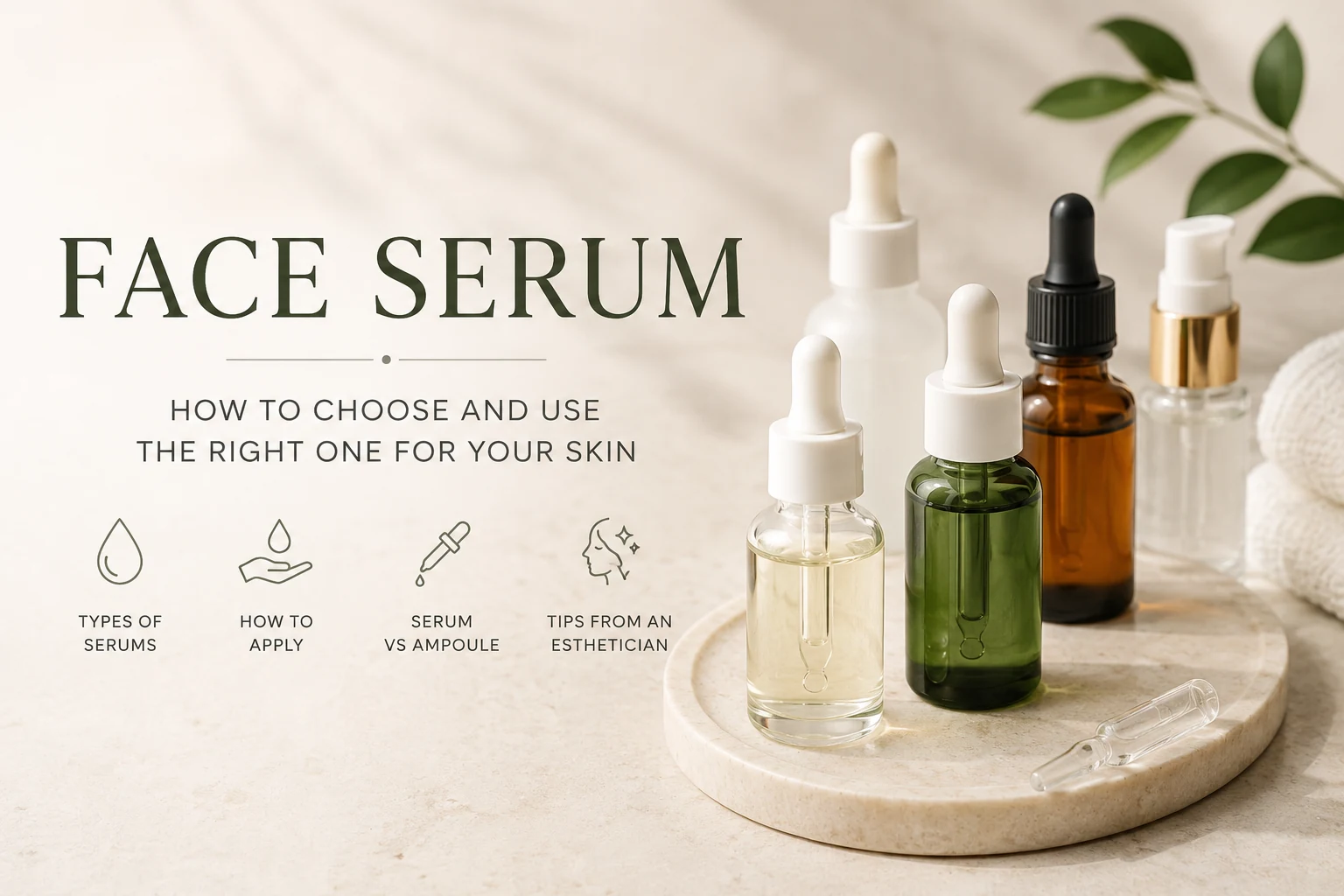
Face serum has always been one of my favorite skincare categories.
Over the years, I have tried many different serums—some for hydration, some for brightness, some for antioxidant support, and others simply because my skin needed a little extra comfort at the time. Even today, I keep several different serums at home and choose between them depending on how my skin looks and feels.
As a licensed esthetician, I have also seen many clients become confused by the growing number of serums available. One promises hydration, another targets dull-looking skin, another contains peptides, and another focuses on supporting the skin barrier.
So which one should you choose?
The answer is not necessarily the most expensive serum or the one with the highest concentration of active ingredients. A good serum should match your current skin condition, your skincare goal, and your skin’s tolerance.
In this guide, I’ll explain what a face serum actually is, the different types of serums you may see, how to choose one for your skin, and how I personally approach serums after many years of working in skincare.
We’ll also briefly talk about ampoules, which are closely related to serums but can be used a little differently depending on the formula and packaging.
What Is a Face Serum?
A face serum is a lightweight skincare product designed to deliver targeted ingredients to the skin.
Unlike a moisturizer, which mainly helps support hydration and reduce water loss from the skin, a serum is usually chosen for a more specific purpose. Depending on the formula, that may include hydration, brightness, antioxidant support, smoother-looking texture, or support for the appearance of mature skin.
Serums can have very different textures. Some feel almost like water, while others are slightly thicker or more silky. The texture alone does not tell you how effective a serum is.
What matters more is the formula, the ingredients, and whether the product is appropriate for your skin.
I also do not believe a serum has to feel strong or tingly to be effective. In my experience, a well-formulated serum that your skin tolerates comfortably and that you can use consistently is often more useful than an aggressive product that causes you to stop using it after a few days.
That is one of the reasons I enjoy serums so much. They allow me to adjust my routine depending on what my skin seems to need at that particular time.
Face Serum Types for Different Skin Needs
One reason serum can feel confusing is that there is no single type of serum. Different formulas are designed for different skincare goals.
Hydrating Face Serums
Hydrating serums are often a good choice for skin that feels dry, tight, or dehydrated. Ingredients such as hyaluronic acid, glycerin, panthenol, and beta-glucan are commonly used to help attract and hold moisture in the skin.
I especially like hydrating serums because they can be useful across many skin types, including mature skin.
Brightening and Antioxidant Face Serums
These serums are designed to help improve the appearance of dull or uneven-looking skin while providing antioxidant support.
Common ingredients may include Vitamin C, ferulic acid, niacinamide, and other antioxidant ingredients.
Vitamin C is one of the most familiar examples, but the most important thing is still how well your skin tolerates the formula.
If you want to learn more, read my guide to Vitamin C serum and how to use it in a simple skincare routine.
Barrier-Support Serums
When skin feels dry, uncomfortable, or easily irritated, I often look for formulas that focus more on supporting the skin barrier.
Ingredients such as ceramides, peptides, panthenol, and soothing humectants may be useful in these types of formulas.
For me, this is a good reminder that serum does not always have to mean “strong active ingredients.” Sometimes the best serum is simply the one that helps the skin feel more comfortable and balanced.
Peptide and Mature-Skin Serums
Peptide serums are popular in routines for mature skin because they are often formulated to support smoother, firmer, healthier-looking skin.
I prefer to think of these as part of a long-term routine rather than a quick fix. Hydration, consistency, and daily sun protection still matter just as much as the serum itself.
Soothing Serums
For skin that looks flushed or feels easily reactive, soothing serums can be helpful.
These may contain ingredients such as Centella asiatica, madecassoside, panthenol, or other calming ingredients designed to help the skin feel more comfortable.
The key is not to own every type of serum. It is to understand what your skin needs and choose accordingly.
How I Choose a Face Serum for My Skin
When I choose a face serum, I do not look only at my skin type.
I pay attention to how my skin feels at that moment.
Some days my skin feels dry and needs more hydration. At other times, I may want antioxidant support, a brighter-looking complexion, or a serum that feels more comforting and nourishing.
That is why I do not believe one serum has to do everything.
I look at three things first:
1. What does my skin need right now?
Dryness, dullness, sensitivity, and changes in texture can all influence what type of serum I reach for.
2. What are the key ingredients?
I always look beyond the front label. Ingredients such as hyaluronic acid, peptides, ceramides, Vitamin C, panthenol, or Centella asiatica can tell me much more about what a product is designed to do.
3. How does my skin respond?
Even a popular or expensive serum is not the right choice if my skin does not feel comfortable using it.
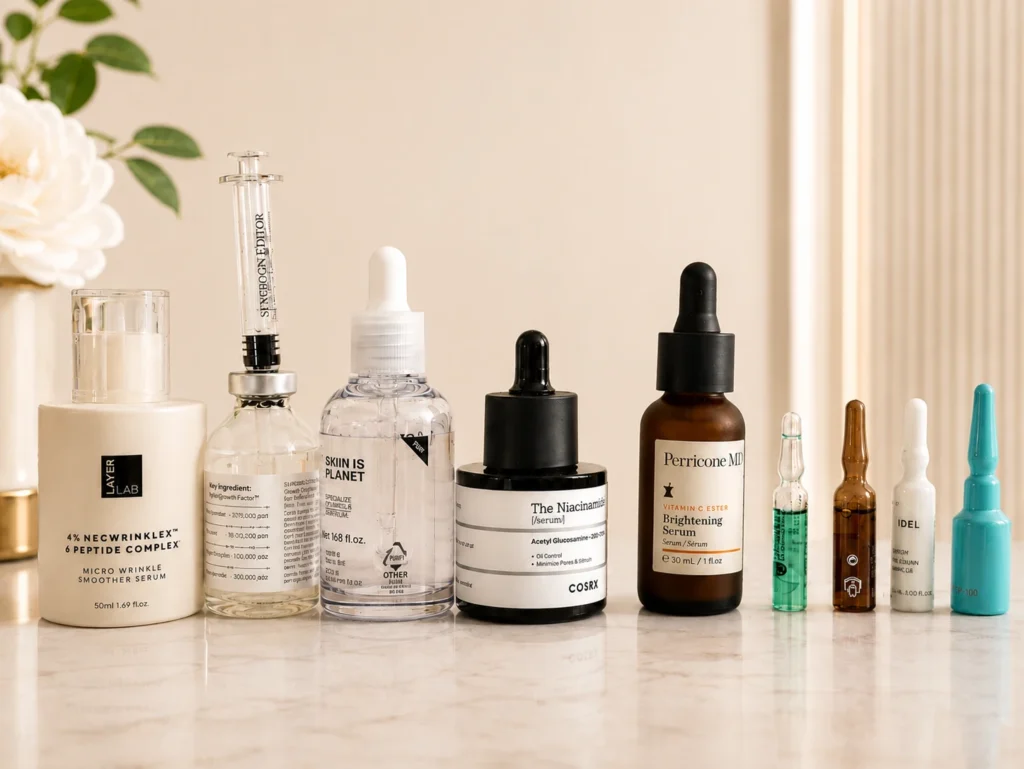
I am definitely a serum lover, and the photo in this article shows only some of the serums and ampoules I currently use at home.
But having several products does not mean I apply all of them at once.
Over the years, both personally and professionally, I have learned that choosing the right product for the skin in front of you is far more important than layering as many serums as possible.
For me, serum is about targeted care, not product overload.
What About Ampoules?
If you enjoy serums, you will probably come across another skincare term: ampoule.
Serums and ampoules are closely related, and there is no universal rule that makes every ampoule stronger or more concentrated than every serum. In everyday skincare, the difference often depends on how a brand formulates and markets the product.
Traditionally, however, ampoules are often presented as a more concentrated or intensive treatment step, while serums are commonly designed for regular daily use.
In professional skincare, I have also worked with a very different type of ampoule.
Some professional ampoules come in small sealed glass vials, sometimes only about the size of a little finger. The tip of the vial is carefully broken open immediately before use. Because the formula remains sealed until that moment, this type of packaging can help minimize exposure to air and outside contamination before use.
Depending on the goal of the treatment, ampoules can also be formulated for different skincare needs.
Soothing and Cica Ampoules
These may contain ingredients such as Centella asiatica, panthenol, and madecassoside. They are commonly chosen when the skin looks flushed or feels sensitive and in need of a more comforting routine.
Barrier-Support Ampoules
Ingredients such as ceramides, peptides, and moisturizing ingredients may be used in formulas designed to support the skin barrier and help dry or stressed-feeling skin feel more balanced and comfortable.
Exfoliating and Pore-Care Ampoules
Some formulas contain AHA, BHA, or PHA to help loosen and remove excess dead skin cells and improve the appearance of rough texture or clogged-looking pores.
Because exfoliating products can be more stimulating, I recommend introducing them carefully rather than assuming that more frequent use will produce better results.
Antioxidant Ampoules
These may include ingredients such as Vitamin C, ferulic acid, or glutathione to provide antioxidant support and help improve the appearance of dull, tired-looking skin.
Just as with serum, I would not choose an ampoule simply because the word “ampoule” sounds more powerful.
I look at the skin type, current skin condition, desired result, key ingredients, and how the skin responds.
The name on the bottle is useful, but the formula inside the bottle matters much more.
How to Apply Face Serum Correctly
A good serum does not need a complicated routine.
For most people, I recommend keeping the order simple:
The American Academy of Dermatology also emphasizes that the order of skincare products matters, with treatment products applied before moisturizer and sunscreen.
Cleanser → Toner → Serum → Moisturizer → Sunscreen in the morning
After cleansing, apply a small amount of serum and spread it gently over the face. Most serums do not need to be applied in a thick layer.
If I am using more than one serum, I usually begin with the lighter, more watery texture and follow with the slightly richer formula.
But I do not believe everyone needs to layer several serums at the same time.
In fact, when too many active products are combined, it can become difficult to know which product is actually helping—or which one may be making the skin feel uncomfortable.
Personally, I prefer to choose one or two serums that match what my skin needs that day.
I also like to give a serum a little time to settle before applying the next product. There is no strict waiting rule for every formula, but allowing the serum to absorb comfortably can make layering feel smoother.
Finally, remember that a serum does not replace moisturizer.
Serum provides targeted skincare ingredients, while moisturizer helps keep the skin comfortable and supports hydration. And during the daytime, sunscreen should always be the final skincare step.
Common Face Serum Mistakes to Avoid
Serums can be very effective, but more is not always better.
One of the most common mistakes I see is using too many active serums at the same time. When several strong formulas are layered together, the skin may become uncomfortable, and it becomes difficult to know which product is actually causing the problem.
Another mistake is choosing a serum because it is popular rather than because it matches your skin.
A product that works beautifully for someone else may not be the best choice for you.
I also recommend avoiding the idea that a serum must tingle, sting, or feel strong in order to be effective. Skincare should not have to feel uncomfortable to be useful.
Finally, do not forget the basics.
A good serum works best as part of a balanced routine that includes gentle cleansing, adequate moisture, and daily sun protection.
Serum should support your routine—not make it unnecessarily complicated.
Final Thoughts From an Esthetician
After many years of working with skin—and after trying more serums than I can probably count—I have learned that the best serum is not necessarily the newest, strongest, or most expensive one.
The best face serum is the one that fits what your skin needs at that particular time and that your skin can use comfortably and consistently.
That is why I enjoy serums so much. They give me the flexibility to adjust my routine. Some days I want more hydration. At other times, I may reach for antioxidant support, peptides, or a calming formula.
Ampoules can also be a useful part of skincare, especially when a more focused treatment is desired, but the same principle applies: look beyond the name on the bottle and pay attention to the ingredients, formula, and your own skin response.
You do not need a shelf full of products to have a good skincare routine.
Choose thoughtfully, introduce new products gradually, and give your skin time to respond.
For me, that has always been the most practical way to use a serum—and one of the reasons it remains my favorite skincare category.
This article is written from the perspective of a licensed esthetician for general cosmetic skincare education. It is not intended to diagnose or treat a medical skin condition. If you experience persistent irritation, pain, swelling, or another concerning skin reaction, consult a dermatologist or other qualified medical professional.
Leave a Reply