
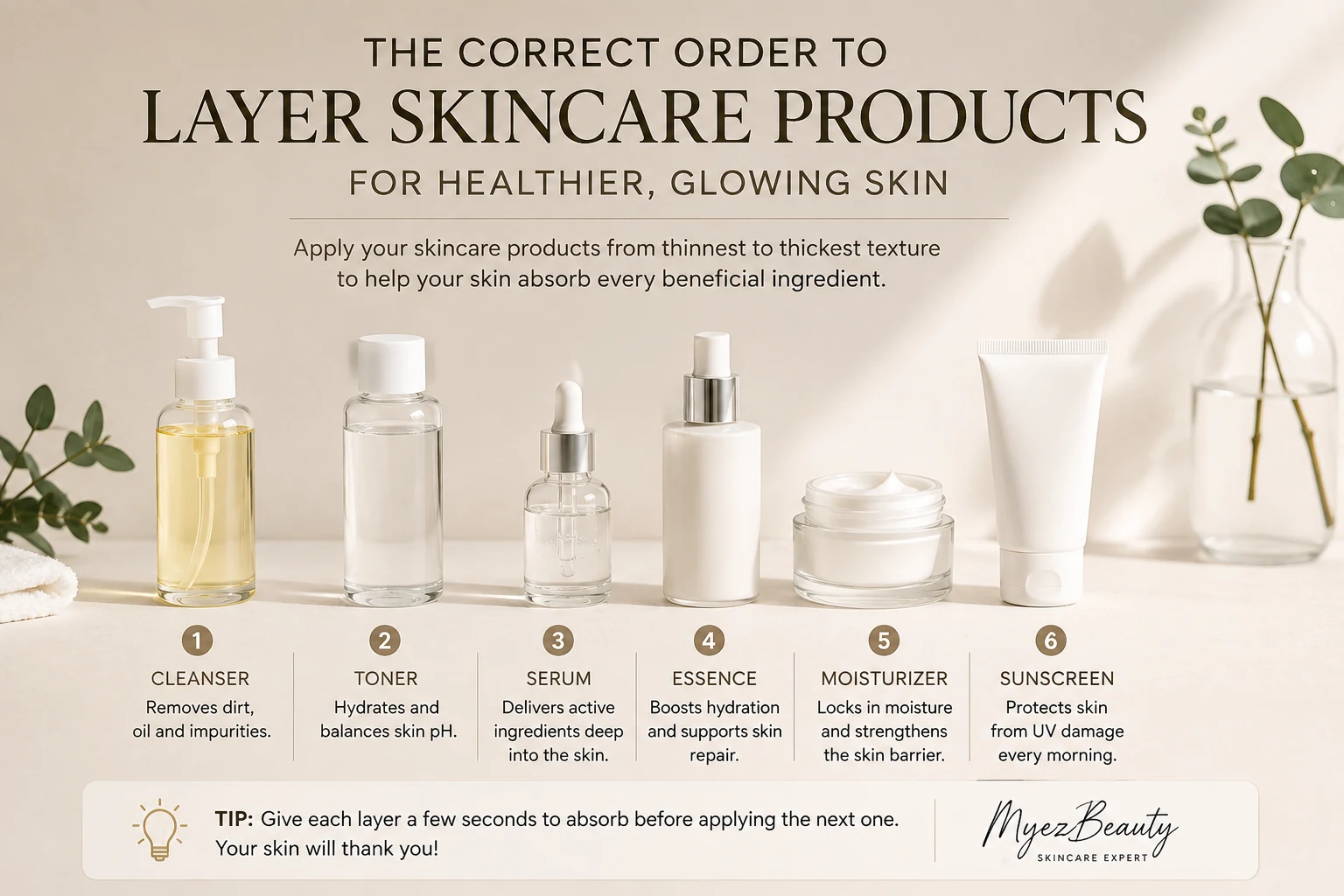
Learning how to layer skincare products in the correct order can help each step of your routine work more effectively without overwhelming your skin.
Healthy skin isn’t just about using expensive skincare products—it’s about using the right products in the right order.
Why the Order Matters When You Layer Skincare Products
How Product Order Affects Your Skin
Healthy skin isn’t just about using expensive skincare products—it’s about using the right products in the right order.
Over the past 30 years as a licensed esthetician, I’ve met many clients who invested in high-quality skincare but were disappointed with their results. Surprisingly, the problem often wasn’t the products themselves. It was how they were being used.
The order in which you apply skincare products directly affects how well your skin absorbs beneficial ingredients. Even the most advanced serum or moisturizer can’t perform at its best if it’s applied at the wrong time.
Think of your skincare routine like building a strong house. Every layer depends on the one beneath it. If the foundation is weak, the rest of the structure becomes less effective.
The same principle applies to skincare.
Each product has a unique purpose. Cleansers remove impurities, toners prepare the skin, serums deliver concentrated active ingredients, moisturizers strengthen the skin barrier, and sunscreen protects everything you’ve worked to achieve.
When these products are applied in the correct order, they work together as a complete skincare system instead of competing with one another.
A Simple Rule for Layering Skincare Products
The good news is that you don’t need a complicated ten-step routine to achieve healthy skin. What matters most is understanding why each step exists and when it should be used.
Whether you’re new to skincare or looking to improve your current routine, this guide will help you layer your products correctly, avoid common mistakes, and build a routine that supports healthier, stronger, and more radiant skin.
As an esthetician, my philosophy has always been simple: healthy skin comes from consistency, gentle care, and understanding what your skin truly needs—not from using the greatest number of products.
Let’s begin by understanding why the order of your skincare routine matters so much.
Your morning skincare routine has one primary purpose: to prepare and protect your skin for the day ahead.
During the day, your skin is exposed to sunlight, pollution, temperature changes, and environmental stressors that can contribute to premature aging and dehydration.
A well-structured morning routine helps maintain hydration, strengthens the skin barrier, and provides daily protection against UV damage.
Rather than using a large number of products, focus on choosing products that work well together and apply them in the correct order.
The following routine is suitable for most skin types and can be adjusted based on your individual skin concerns.
Morning Skincare Routine
A morning routine should focus on hydration, protection, and applying products from lighter to richer textures. When you layer skincare products in the correct order, each step can work without making the routine unnecessarily complicated.
Step 1 – Gentle Cleanser
Start with a mild cleanser that removes overnight oil and buildup without leaving the skin feeling tight. Very dry or sensitive skin may sometimes need only a lukewarm-water rinse in the morning.
Step 2 – Toner or Essence
Apply a lightweight toner or essence to add hydration and prepare the skin for the products that follow. Choose gentle formulas that fit your skin type.
Step 3 – Treatment Serum
Next, apply a serum based on your skincare goals. Hydrating serums, niacinamide, or vitamin C are common morning options, but you do not need several serums at once.
Step 4 – Eye Cream
Eye cream is optional. If you use one, apply a small amount around the eye area before heavier moisturizers.
Step 5 – Moisturizer
Moisturizer helps reduce moisture loss and support the skin barrier. Choose a lightweight lotion or a richer cream depending on your skin’s needs.
Step 6 – Sunscreen
Finish with broad-spectrum SPF 30 or higher. Sunscreen should be the final skincare step before makeup and is one of the most important parts of a daytime routine.
A simple morning routine is often enough: cleanse, hydrate, treat, moisturize, and protect. Consistency matters more than adding unnecessary steps.
Evening Skincare Routine
An evening routine should focus on removing sunscreen and makeup, replenishing hydration, and supporting the skin overnight. When you layer skincare products at night, start with cleansing and finish with products that help lock in moisture.
Step 1 – Remove Makeup and Sunscreen
If you wear makeup or water-resistant sunscreen, begin with a cleansing balm, cleansing oil, or micellar water.
Step 2 – Gentle Water-Based Cleanser
Follow with a mild cleanser to remove remaining buildup without stripping the skin.
Step 3 – Hydrating Toner or Essence
Apply a lightweight toner or essence to add hydration and prepare the skin for treatment products.
Step 4 – Treatment Products
Use treatments according to your skin’s needs. Retinol, exfoliating acids, or other active ingredients should be introduced gradually rather than layered together unnecessarily.
Hydrating ingredients such as hyaluronic acid and barrier-supporting ingredients such as ceramides can also be included when appropriate.
Step 5 – Moisturizer
Apply moisturizer to help reduce moisture loss and support the skin barrier overnight.
Step 6 – Facial Oil, Optional
If your skin is very dry, a few drops of facial oil can be applied as the final step. This step is optional and may not be necessary for every skin type.
A well-layered evening routine does not need to be complicated. Gentle cleansing, targeted treatment, and adequate moisture are usually enough.
Common Layering Mistakes to Avoid
Even good skincare products can become less effective when they are layered incorrectly. Keep your routine simple and pay attention to how your skin responds.
Applying Products Too Quickly
You do not need to wait several minutes between every step, but allow each product a moment to settle before applying the next layer.
Using Too Many Active Ingredients at Once
Combining several strong acids, retinoids, or other active ingredients in one routine can increase dryness or irritation. Introduce them gradually.
Skipping Moisturizer
Moisturizer helps reduce moisture loss and supports the skin barrier. Even oily skin can benefit from a lightweight formula.
Forgetting Sunscreen
Sunscreen should be the final step of your morning skincare routine. Daily broad-spectrum SPF 30 or higher helps protect the skin from UV exposure.
The best way to layer skincare products is to keep the routine balanced, consistent, and appropriate for your individual skin needs.
Skincare Routine by Skin Type
The correct order for layering skincare products stays similar for most people, but product texture and intensity should be adjusted to your skin type.
Dry Skin
Focus on gentle cleansing, hydrating serums, and a richer moisturizer. Ingredients such as hyaluronic acid, glycerin, ceramides, and squalane can help support hydration and reduce moisture loss.
Oily Skin
Choose lightweight, non-comedogenic products and avoid stripping cleansers. A hydrating serum and lightweight moisturizer can help keep the routine balanced without feeling heavy.
Combination Skin
Use lightweight hydration across the face and apply richer moisturizer only where needed. Avoid treating every area of the face exactly the same.
Sensitive Skin
Keep the routine simple and introduce new products one at a time. Fragrance-free, gentle formulas and barrier-supporting ingredients are often easier to tolerate.
Mature Skin
Prioritize hydration, moisturizer, daily sunscreen, and carefully selected active ingredients. Consistency is more important than using a large number of products.
No matter your skin type, the best way to layer skincare products is to start with lighter textures and finish with products that help seal in moisture and protect the skin.
Professional Tips from an Esthetician
Throughout my career as a licensed esthetician, I’ve learned that healthy skin is rarely the result of one miracle product.
Instead, it comes from understanding your skin, using products consistently, and protecting your skin barrier every day.
Many clients ask me which product is the most important.
My answer is always the same:
The best skincare routine is the one you can follow consistently.
Simple routines performed every day almost always outperform complicated routines that are difficult to maintain.
Listen to your skin.
If it feels irritated, dry, or overly sensitive, simplify your routine rather than adding more products.
Healthy skin should feel comfortable, balanced, and resilient—not tight, burning, or overwhelmed.
With patience and consistency, small daily habits create remarkable long-term results.
Frequently Asked Questions
Should I wait between applying skincare products?
Waiting 30 to 60 seconds between lightweight products is usually sufficient. The goal is to allow each layer to absorb without unnecessarily extending your routine.
Can I use Vitamin C and Retinol together?
Many people prefer using Vitamin C in the morning and Retinol at night. This approach helps simplify your routine while minimizing the chance of irritation.
Is toner necessary?
Not everyone needs a toner, but a hydrating toner or essence can improve moisture levels and help prepare the skin for the products that follow.
Do I need both Hyaluronic Acid and Ceramides?
Yes. These ingredients perform different functions and complement each other well.
Hyaluronic acid attracts moisture into the skin, while ceramides help keep that moisture from escaping by strengthening the skin barrier.
Can oily skin skip moisturizer?
No.
Even oily skin needs hydration. Choosing a lightweight moisturizer helps maintain balance and may actually reduce excess oil production over time.
Final Thoughts
Learning how to layer skincare products correctly is one of the simplest ways to improve your skincare routine without purchasing additional products.
The order in which you apply your products affects how well your skin can absorb beneficial ingredients and how effectively each product performs.