
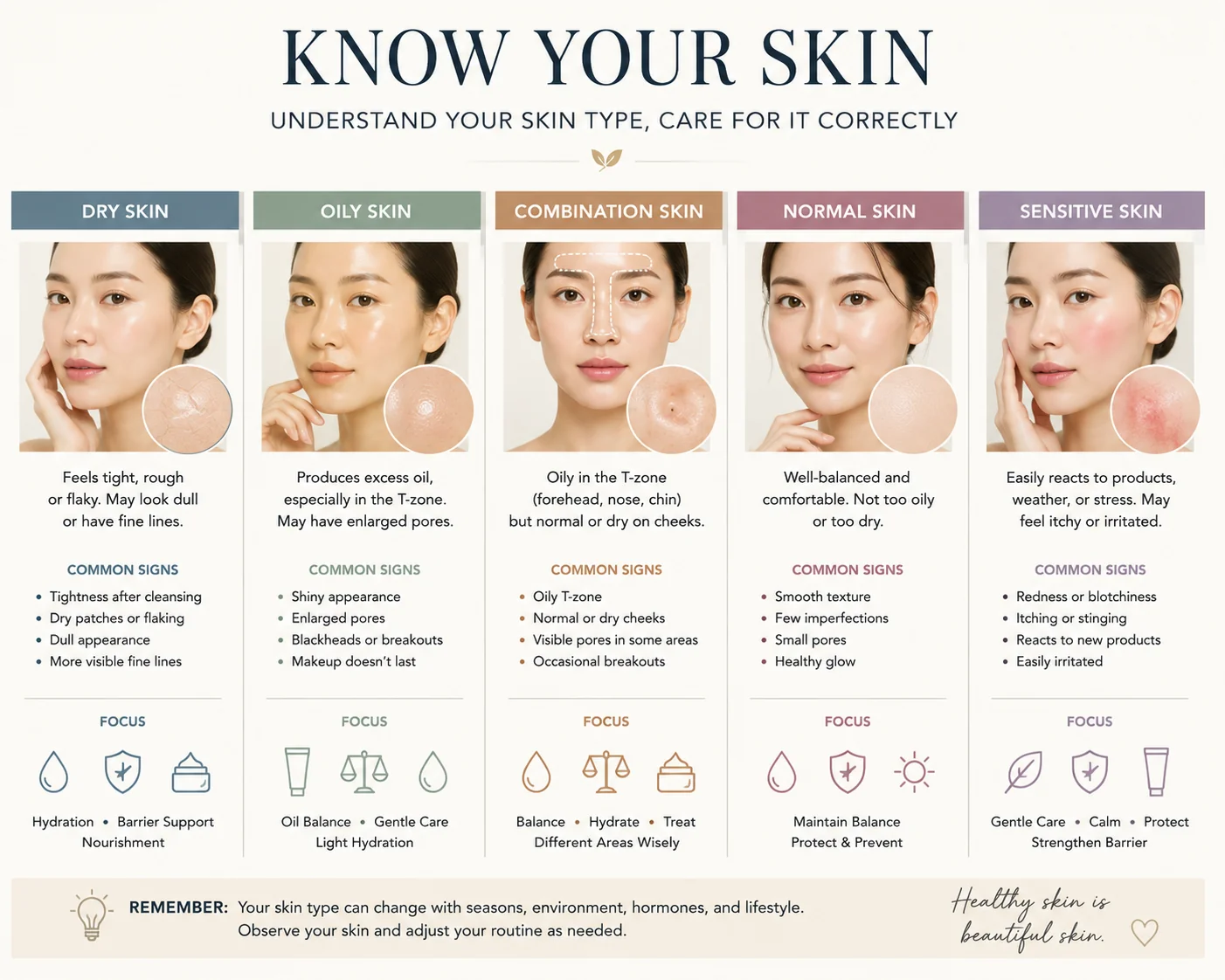
Learning how to determine your skin type is only the beginning of understanding what your skin really needs. In my years of working with clients as an esthetician, I’ve found that many people have a general idea of whether their skin is dry, oily, combination, or sensitive. The bigger challenge is knowing how to care for that skin correctly.
Your skin type provides an important starting point, but your skin does not behave exactly the same way every day—or even every season. Age, climate, humidity, indoor heating, sun exposure, skincare products, and lifestyle can all influence how your skin looks and feels.
This is something I see clearly living and working in the Northeast, where we experience four distinct seasons. A client whose skin feels comfortable in spring may suddenly struggle with dryness and tightness during a cold winter, while the same skin may need lighter products during a hot, humid summer.
That is why I believe good skincare begins with two things: understanding your basic skin type and learning to observe what your skin is telling you right now.
In this guide, I’ll explain how to determine your skin type, how to distinguish skin type from temporary skin conditions, and how to care for dry, oily, combination, normal, and sensitive skin. We’ll also look at how your skincare routine may need to change with the seasons—because healthy skin is not about following the exact same routine all year. It is about giving your skin what it needs when it needs it.
Skin Type vs. Skin Condition: What’s the Difference?
Before learning how to determine your skin type, it is important to understand the difference between your skin type and your current skin condition. These two are often confused, and that confusion can lead people to choose products their skin may not actually need.
Your basic skin type is largely influenced by factors such as genetics and the amount of oil your skin naturally produces. It is commonly described as normal, dry, oily, or combination.
A skin condition, however, can change. Dehydration, sensitivity, irritation, breakouts, and temporary dryness can appear because of weather, environment, lifestyle, or the skincare products you are using.
Dry Skin Is Not Always Dehydrated Skin
This is one of the most common misunderstandings I see.
Dry skin generally lacks oil, while dehydrated skin lacks water. Because dehydration is a skin condition rather than simply a skin type, even someone with oily skin can experience dehydration.
For example, oily skin that feels tight after cleansing does not necessarily need stronger cleansing or more oil-control products. The skin may actually need gentler cleansing and better hydration.
This distinction matters because good skincare is not about treating a label. It is about understanding what your skin needs at that particular time.
What I Look for as an Esthetician
When I evaluate someone’s skin, I don’t look at oiliness or dryness alone. I also pay attention to texture, hydration, sensitivity, visible irritation, how the skin responds to products, and changes the client has noticed over time.
That is why two people who both describe themselves as having “dry skin” may need very different routines.
Your skin type gives us a starting point. Your skin condition tells us what may need attention today.
How to Determine Your Skin Type at Home
You do not need complicated equipment to begin understanding your skin. A simple observation of how your skin behaves after cleansing can give you useful clues.
Start by washing your face with a gentle cleanser and patting it dry. For this observation, avoid immediately applying toner, serum, moisturizer, or facial oil. Give your skin a little time to settle naturally, then pay attention to how different areas of your face look and feel.
Signs of Dry Skin
Your skin may lean dry if it frequently:
- Feels tight or uncomfortable after cleansing
- Looks dull, rough, or flaky
- Produces relatively little visible oil
- Feels as though it needs moisturizer quickly
- Shows fine dehydration lines more easily when moisture levels are low
Signs of Oily Skin
Your skin may lean oily if:
- Shine develops relatively quickly, especially through the T-zone
- Oiliness appears beyond just the nose and forehead
- Pores may appear more noticeable in oilier areas
- Makeup tends to become shiny or move more easily during the day
Remember, oily skin can still become dehydrated or irritated, especially when it is over-cleansed or over-exfoliated.
Signs of Combination Skin
Combination skin usually behaves differently in different areas of the face.
You may notice more oil through the forehead, nose, and chin, while the cheeks feel normal or dry. This means you may not need to treat every part of your face exactly the same way.
Signs of Normal Skin
Normal skin generally feels balanced. It is neither excessively oily nor persistently dry and usually feels comfortable after gentle cleansing.
But “normal” does not mean your skin requires no care. Hydration, barrier support, and daily sun protection are still important for maintaining healthy skin.
What About Sensitive Skin?
Sensitive skin deserves special attention because sensitivity can overlap with any skin type.
Someone can have dry and sensitive skin, oily and sensitive skin, or combination skin that becomes easily irritated. Frequent burning, stinging, redness, or reactions to products should not simply be dismissed as “my skin type.”
If reactions are persistent, severe, painful, or difficult to understand, it is appropriate to consult a board-certified dermatologist rather than continually experimenting with new skincare products.
How to Care for Each Skin Type
Knowing your skin type is useful only when you understand how to care for it. In my experience working with clients, this is where many people struggle. They may know they have dry, oily, or combination skin, but they continue using products or routines that work against what their skin actually needs.
The goal is not to force your skin into another skin type. The goal is to support healthy, comfortable, well-balanced skin.
How to Care for Dry Skin
Dry skin usually benefits from a routine that cleanses without stripping away too much natural oil and replaces both water and lipids.
Choose a gentle cleanser and avoid washing with very hot water. After cleansing, apply hydrating products while the skin is still slightly damp, followed by a moisturizer that helps reduce moisture loss.
Ingredients such as glycerin, hyaluronic acid, ceramides, and squalane can be useful depending on the formulation and your individual skin.
At night, very dry skin may benefit from a richer moisturizer, especially during colder months.
One mistake I often see is focusing only on adding more moisturizer while continuing to use an overly harsh cleanser. Good dry-skin care begins with protecting the skin barrier from the cleansing step onward.
How to Care for Oily Skin
Oily skin does not need to be scrubbed, stripped, or dried out.
This is one of the most important things I tell people with oily skin. Using harsh cleansers, excessive exfoliation, or multiple oil-control products can leave the skin irritated and uncomfortable.
Instead, use a gentle cleanser and choose lightweight hydration and moisturizer appropriate for your skin. Look for textures such as light lotions or gels if richer creams feel too heavy.
And do not skip moisturizer simply because your skin produces oil. Oil and hydration are not the same thing.
How to Care for Combination Skin
Combination skin often requires flexibility.
If your T-zone becomes oily while your cheeks feel dry or comfortable, you do not necessarily need to apply the exact same amount or texture of product everywhere.
A lightweight moisturizer may work well over the entire face, while drier areas can receive a little more moisturizer when needed.
This is where learning to observe your skin becomes more useful than rigidly following a routine.
How to Care for Normal Skin
If your skin is naturally balanced, keep the routine simple and consistent.
A gentle cleanser, adequate hydration, moisturizer as needed, and daily broad-spectrum sunscreen can form an excellent foundation.
Normal skin does not need aggressive treatments simply because they are popular. Maintaining a healthy skin barrier is often more valuable than constantly introducing new active ingredients.
How to Care for Sensitive Skin
Sensitive skin usually responds best to a simple, gentle routine.
Introduce new products one at a time rather than changing several products at once. Fragrance-free formulas may be helpful for people who are easily irritated, and patch testing can be useful before introducing a new product more broadly.
Most importantly, persistent redness, burning, itching, swelling, or recurring reactions should not automatically be treated as a cosmetic skincare problem. Sometimes professional medical evaluation is the appropriate next step.
With sensitive skin, more skincare is not always better. Sometimes simplifying the routine is exactly what the skin needs.
Why Your Skin Type Needs a Different Routine With the Seasons

Knowing how to determine your skin type gives you a foundation, but good skincare should also respond to your environment.
Living and working in the Northeast, I see this clearly with my clients. We experience four distinct seasons, and the same person’s skin can behave very differently in January than it does in July.
This does not necessarily mean your basic skin type has completely changed. More often, your skin condition and what it needs from your routine have changed with the environment.
Winter: Protect Against Dryness and Moisture Loss
Cold outdoor air combined with dry indoor heating can leave skin feeling tight, rough, or uncomfortable.
During winter, I often recommend shifting toward gentler cleansing, more hydration, and richer barrier-supporting moisturizers when the skin needs them.
This is also a good time to pay attention to ingredients such as ceramides and other moisturizing ingredients that help support the skin barrier.
If your skin becomes especially dry during winter, do not assume you suddenly need aggressive exfoliation to remove every flake. Sometimes the skin needs less irritation and more barrier support.
Spring: Adjust Gradually
Spring is a transition season. Temperatures rise, humidity begins to change, and a heavy winter routine may start feeling like too much.
Rather than replacing your entire skincare routine at once, observe your skin and make small adjustments.
You might switch from a very rich moisturizer to a lighter cream or lotion while continuing the hydration and sun protection your skin needs.
Summer: Lighten the Texture, Not the Protection
Hot, humid weather can make skin feel oilier, especially through the T-zone.
This is often a good time to use lighter moisturizers and comfortable sunscreen formulations, particularly if heavier products feel greasy.
But summer is not the time to abandon hydration. Air conditioning, sun exposure, swimming, and frequent cleansing can still leave skin dehydrated.
And regardless of skin type, daily broad-spectrum sun protection remains essential.
Fall: Prepare the Skin for Colder Weather
Fall is another transition period and a good time to watch for the first signs of seasonal dryness.
As temperatures and humidity begin to drop, gradually increase hydration or move toward a slightly richer moisturizer if your skin starts feeling tighter.
There is no need to wait until your skin becomes extremely dry or irritated before adjusting your routine.
My Esthetician Approach to Seasonal Skincare
I don’t believe everyone needs four completely different skincare routines for four seasons.
Instead, keep a strong basic routine and learn which parts need adjusting.
Your cleanser may need to become gentler. Your moisturizer may need to become richer or lighter. You may need more hydration at certain times of the year.
The foundation stays consistent. The details change according to what your skin is telling you.
That’s one of the most valuable skincare habits you can develop: not simply following a routine, but learning how to respond to your skin.
Common Skin Type Guide Mistakes I See as an Esthetician
Over the years, I have noticed that many skincare problems do not begin because people completely misunderstand their skin type. More often, they happen because people choose a routine that does not match what their skin actually needs.
1. Trying to “Dry Out” Oily Skin
One of the most common mistakes is assuming that oily skin needs stronger cleansing and less moisture.
Over-cleansing, harsh scrubs, and excessive exfoliation can leave the skin feeling tight and irritated. Oily skin still needs hydration and a healthy skin barrier.
The goal should be balance—not removing every trace of oil from the skin.
2. Confusing Dry Skin With Dehydrated Skin
Someone may notice tightness or fine dehydration lines and immediately decide that they have dry skin.
But remember: dry skin lacks oil, while dehydrated skin lacks water. Even oily or combination skin can become dehydrated.
Understanding the difference can completely change the way you approach your routine.
3. Using the Same Routine All Year
This is especially important where I live in the Northeast.
A rich moisturizer that feels wonderful during a cold, dry January may feel too heavy in July. Likewise, a lightweight summer moisturizer may not provide enough comfort when indoor heating and cold weather arrive.
Your routine does not need to change completely, but it should have enough flexibility to respond to seasonal changes.
4. Following Trends Instead of Your Skin
A product can be popular, expensive, or highly recommended online and still not be right for your skin.
I encourage my clients to ask a simple question:
“What does my skin need?”
That question is often more useful than asking what everyone else is using.
5. Changing Too Many Products at Once
When several new products are introduced at the same time, it becomes difficult to know which product is helping—or which one may be causing irritation.
Introduce new products thoughtfully and give your skin time to respond.
Skincare does not need to be complicated to be effective. Consistency, observation, and appropriate product choices are often more valuable than having a crowded bathroom shelf.
Sometimes the best thing you can do for your skin is stop experimenting with more products and seek the appropriate professional guidance.
Final Thoughts: Learn to Listen to Your Skin
Learning how to determine your skin type is an important first step, but it should never become a label that limits the way you care for your skin.
Your basic skin type gives you a foundation. From there, pay attention to hydration, sensitivity, climate, seasonal changes, and how your skin responds to the products you use.
After years of caring for clients, one lesson continues to stand out to me: healthy skin rarely comes from constantly chasing the newest product. It comes from understanding your skin and caring for it consistently.
If your skin feels different in winter than it does in summer, adjust your routine. If oily skin suddenly feels tight and uncomfortable, consider hydration and barrier health before reaching for another oil-control product. And if a popular ingredient repeatedly irritates your skin, you do not need to use it simply because everyone else does.
A good skincare routine should work with your skin, not against it.
Start with the basics: cleanse gently, hydrate appropriately, support your skin barrier, and protect your skin from the sun. Then make thoughtful adjustments as your skin and environment change.
Your skin type tells you where to start. Learning to listen to your skin tells you where to go from there.