
An Esthetician’s Step-by-Step Guide to Healing a Damaged Skin Barrier Naturally
Discover how to repair a damaged skin barrier with an esthetician-approved skincare routine, the best ingredients, and expert tips for healthier skin.
Skin Barrier Repair: Why Healthy Skin Starts Here
If your skin suddenly feels tight, dry, sensitive, or irritated—even after using products you once loved—you may not have a skincare problem. You may have a damaged skin barrier.
As an esthetician, I’ve met countless clients who believed they needed stronger treatments, more expensive products, or longer skincare routines. In reality, many of them simply had a weakened skin barrier.
Healthy skin isn’t about using the most products. It’s about protecting the skin’s natural ability to defend and repair itself.
When your skin barrier is healthy, your complexion feels balanced, smooth, hydrated, and resilient. When it’s damaged, even the gentlest products can sting, redness becomes more noticeable, and moisture disappears quickly.
The good news is that the skin barrier has an amazing ability to recover—when you give it the right support.
In this guide, I’ll explain what the skin barrier is, why it becomes damaged, and the simple skincare routine I recommend to help restore healthy, resilient skin naturally.
What Is the Skin Barrier?
Your skin barrier, often called the skin’s protective barrier or moisture barrier, is the outermost layer of your skin.
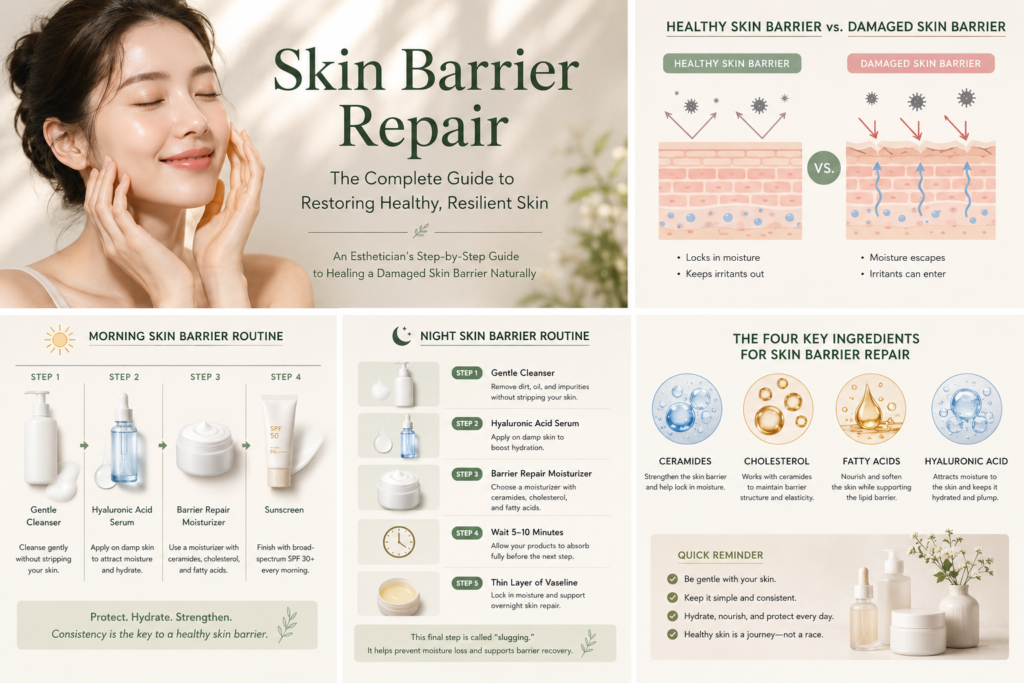
Think of it as a brick wall.
- The skin cells are the bricks.
- Natural lipids—including ceramides, cholesterol, and fatty acids—act as the mortar holding everything together.
This protective layer performs two essential jobs:
1. It keeps moisture inside your skin.
A healthy barrier prevents excessive water loss, allowing your skin to stay soft, plump, and hydrated throughout the day.
2. It keeps harmful irritants out.
Your skin barrier helps protect against pollution, allergens, bacteria, harsh weather, and irritating skincare ingredients.
When this barrier becomes damaged, water escapes more easily while irritants enter more easily. This often creates a cycle of dryness, irritation, redness, and sensitivity.
For this reason, maintaining a healthy skin barrier is one of the most important foundations of long-term skin health.
Why the Skin Barrier Matters More Than You Think
Many people focus on treating wrinkles, acne, dark spots, or uneven texture.
However, if your skin barrier is compromised, even the best anti-aging or brightening products may not perform as expected.
A damaged barrier can cause:
- Persistent dryness
- Increased sensitivity
- Redness
- Flaking
- Burning or stinging after applying skincare
- Breakouts caused by inflammation
- Rough texture
- Difficulty retaining moisture
Instead of continuously adding new products, restoring your skin barrier often allows your skin to function the way it was designed to.
This is one of the biggest lessons I’ve learned throughout my years working with clients: healthy skin begins with a healthy barrier.
Signs Your Skin Barrier May Be Damaged
Not every breakout or dry patch means your skin barrier is damaged, but several symptoms often appear together.
Common signs include:
Your skin feels tight after cleansing.
Even if you apply moisturizer immediately, your skin quickly feels dry again.
Products suddenly sting or burn.
Skincare products you’ve used comfortably for months may suddenly cause irritation.
Redness becomes more frequent.
Sensitive, flushed skin is often one of the earliest warning signs.
Flaking and rough texture appear.
Your skin may look dull and uneven because it cannot hold enough moisture.
Your skin becomes unusually reactive.
Even changes in weather, temperature, or water can trigger irritation.
Breakouts become more common.
A weakened barrier may contribute to inflammation, making acne-prone skin more difficult to manage.
Can a Damaged Skin Barrier Heal?
The answer is encouraging: yes.
In many cases, healthy skin can begin showing noticeable improvement within a few days when irritation is reduced and the right skincare routine is followed consistently.
More significant recovery often takes several weeks, depending on the extent of the damage and individual skin conditions.
The key is patience.
Rather than introducing multiple new products, focus on giving your skin what it truly needs: gentle care, hydration, barrier-supporting ingredients, and time to recover.
What Causes Skin Barrier Damage?
Your skin barrier is remarkably resilient, but it isn’t indestructible.
Modern skincare routines often encourage people to use multiple active ingredients at the same time. While these products can be beneficial when used correctly, overusing them is one of the most common reasons the skin barrier becomes damaged.
Here are the most common causes I see in my practice.
Over-Cleansing
Many people believe that washing their face more often will lead to cleaner, healthier skin.
In reality, cleansing too frequently or using harsh cleansers strips away the natural oils that help keep your skin barrier intact.
If your skin feels tight immediately after cleansing, your cleanser may be too aggressive.
Over-Exfoliation
Exfoliation can improve skin texture and brightness, but too much exfoliation weakens the skin’s protective barrier.
Using scrubs, AHAs, BHAs, or exfoliating pads too often may leave your skin irritated, sensitive, and dehydrated.
When your skin barrier is compromised, less is often more.
Using Too Many Active Ingredients
Retinol, vitamin C, glycolic acid, salicylic acid, and exfoliating treatments all have their place.
However, layering several active ingredients in the same routine can overwhelm your skin.
Instead of achieving faster results, you may experience redness, burning, dryness, and increased sensitivity.
Healthy skin responds better to consistency than intensity.
Sun Exposure
Ultraviolet (UV) rays damage the skin barrier every single day—even when it’s cloudy.
Without daily sunscreen, your skin loses moisture more easily and becomes more vulnerable to inflammation and premature aging.
Sun protection isn’t just about preventing wrinkles; it’s also one of the best ways to protect your skin barrier.
Environmental Stress
Cold weather, low humidity, air conditioning, pollution, and even long hot showers can weaken your skin’s protective layer.
While you can’t always control your environment, you can strengthen your skin with the right skincare routine.
Stress and Lack of Sleep
Your skin repairs itself while you sleep.
Chronic stress and poor sleep can slow down this natural repair process, making it harder for your skin barrier to recover.
Healthy skin reflects healthy habits.
The Four Ingredients I Recommend Most
As an esthetician, I’ve learned that repairing the skin barrier isn’t about buying the most expensive products.
It’s about choosing ingredients that support your skin’s natural structure.
These are the four ingredients I recommend most often.
Ceramides
Ceramides are naturally found in healthy skin and make up a significant portion of your skin barrier.
Think of ceramides as the glue that helps hold skin cells together.
When ceramide levels decrease, moisture escapes more easily, leaving the skin dry, rough, and vulnerable.
Using a moisturizer containing ceramides can help reinforce the skin barrier and reduce moisture loss.
Cholesterol
Many people are surprised to learn that cholesterol isn’t just found inside the body—it also plays an essential role in healthy skin.
Cholesterol works together with ceramides to strengthen the skin barrier and improve its ability to retain moisture.
When these ingredients are combined, they help support the skin’s natural repair process.
Fatty Acids
Fatty acids nourish the skin and help restore softness and flexibility.
They also work alongside ceramides and cholesterol to rebuild the protective lipid layer that healthy skin depends on.
This is why many barrier-repair creams include all three ingredients together.
Hyaluronic Acid
Hyaluronic acid is one of the best ingredients for increasing hydration.
It attracts water to the skin, helping your complexion feel smoother, plumper, and more comfortable.
While hyaluronic acid doesn’t repair the skin barrier by itself, it provides the hydration your skin needs while the barrier heals.
My Recommended Morning Skin Barrier Routine
When your skin barrier is damaged, simplicity is your greatest ally.
A gentle, consistent morning routine can help reduce irritation while giving your skin the support it needs to recover.
Step 1: Cleanse Gently
Use a mild, fragrance-free cleanser that removes impurities without stripping away your skin’s natural oils.
Your skin should feel clean—but never tight.
Step 2: Apply a Hyaluronic Acid Serum
While your skin is still slightly damp, apply a hydrating serum containing hyaluronic acid.
This helps attract moisture into the skin and prepares it for the next steps.
Step 3: Use a Barrier-Repair Moisturizer
Choose a moisturizer that contains ceramides, cholesterol, and fatty acids.
These ingredients work together to replenish the lipids that help keep your skin healthy and resilient.
Step 4: Never Skip Sunscreen
Finish with a broad-spectrum sunscreen of SPF 30 or higher every morning.
Protecting your skin from UV damage is one of the most effective ways to support long-term skin barrier health.
My Recommended Night Skin Barrier Repair Routine
Your skin performs most of its repair work while you sleep. That’s why a simple, nourishing nighttime routine can make a significant difference when your skin barrier is compromised.
Instead of using multiple active ingredients, focus on hydration, nourishment, and protection.
Step 1: Cleanse with a Gentle Cleanser
Start by removing sunscreen, makeup, dirt, and excess oil with a mild cleanser.
Avoid cleansers that leave your skin feeling squeaky clean or tight. Your skin should feel refreshed—not stripped.
Step 2: Apply a Hyaluronic Acid Serum
After cleansing, apply a generous layer of a hyaluronic acid serum while your skin is still slightly damp.
Hydrated skin creates a better environment for the skin barrier to repair itself overnight.
Step 3: Apply a Barrier Repair Moisturizer
Next, use a moisturizer that contains a combination of:
- Ceramides
- Cholesterol
- Fatty Acids
These three lipids naturally exist in healthy skin and work together to reinforce the skin barrier.
When shopping for a moisturizer, look for formulas that contain all three rather than just one.
Step 4: Wait 5–10 Minutes
Give your skincare products a few minutes to absorb before moving to the final step.
Waiting allows your moisturizer to settle into the skin instead of being diluted or displaced by the next product.
Step 5: Seal Everything In with a Thin Layer of Vaseline
One of the simplest and most effective ways to reduce overnight moisture loss is to apply a very thin layer of Vaseline (petrolatum) over your moisturizer.
This technique, often called slugging, helps lock in hydration and supports the skin’s natural recovery process.
Contrary to popular belief, petrolatum does not add moisture to the skin. Instead, it creates a protective seal that helps prevent water from evaporating while your skin repairs itself overnight.
If your skin is extremely oily or acne-prone, start by using this technique only two or three nights a week to see how your skin responds.
How Soon Will You Notice Results?
Many people expect immediate improvement, but skin barrier repair requires consistency.
In my experience, many people notice that their skin feels calmer, softer, and more comfortable within just a few days of following a gentle routine.
More significant improvements—such as reduced redness, better hydration, and improved resilience—often become noticeable over the following several weeks.
The goal isn’t overnight perfection. The goal is healthy skin that becomes stronger over time.
Common Mistakes That Slow Down Skin Barrier Recovery
Even with the best products, certain habits can delay your skin’s healing process.
Using Too Many Products
Adding more products doesn’t always produce better results.
When your skin barrier is damaged, a simple routine is often the most effective one.
Exfoliating Too Soon
It’s tempting to exfoliate flaky skin, but doing so before your skin has recovered can worsen irritation.
Wait until your skin feels comfortable again before reintroducing exfoliating acids or scrubs.
Skipping Moisturizer
Some people avoid moisturizer because they think it will make their skin oily.
In reality, a damaged skin barrier needs moisture and lipids to repair itself effectively.
Forgetting Sunscreen
Every day without sunscreen exposes your recovering skin to UV damage.
Daily sun protection is one of the most important steps in maintaining a healthy skin barrier.
Constantly Switching Products
Give your skincare routine time to work.
Changing products every few days makes it difficult to know what’s helping—and may keep your skin in a constant state of irritation.
Remember: Healthy Skin Is Built Through Consistency
There is no single miracle product that can repair your skin barrier overnight.
What truly makes a difference is using gentle, effective products consistently and giving your skin the time it needs to recover.
Small daily habits often produce the biggest long-term results.
Frequently Asked Questions About Skin Barrier Repair
How long does it take to repair a damaged skin barrier?
The answer depends on how severely the barrier has been damaged and how consistent you are with your skincare routine.
Many people notice that their skin feels calmer and more hydrated within a few days. However, more noticeable improvements in texture, sensitivity, and overall skin health often take several weeks.
Consistency is far more important than using many different products.
Can I use retinol while repairing my skin barrier?
If your skin is already irritated, sensitive, or inflamed, it is generally best to pause retinol until your skin barrier has recovered.
Once your skin feels comfortable again, you can slowly reintroduce retinol by using it one or two nights per week and increasing the frequency as your skin tolerates it.
Is Vaseline really good for repairing the skin barrier?
Yes. Vaseline (petrolatum) is one of the most effective occlusive ingredients available.
While it doesn’t hydrate the skin directly, it helps reduce water loss by creating a protective layer over your moisturizer. This allows your skin barrier to recover more efficiently.
For best results, apply a thin layer as the final step of your nighttime routine after waiting 5–10 minutes for your moisturizer to absorb.
Can oily skin have a damaged skin barrier?
Absolutely.
Many people with oily skin mistakenly believe that they should avoid moisturizers or cleanse their skin more often.
In reality, over-cleansing and overusing exfoliating products are common reasons oily skin develops a damaged skin barrier.
Even oily skin needs hydration and barrier-supporting ingredients.
What ingredients should I avoid while my skin barrier heals?
While your skin is recovering, it’s often helpful to minimize products that may increase irritation, including:
- Physical scrubs
- Strong exfoliating acids (AHA/BHA)
- High concentrations of retinol
- Alcohol-heavy toners
- Fragranced products if your skin is very sensitive
Choose gentle, fragrance-free products whenever possible.
Final Thoughts from an Esthetician
Throughout my years as an esthetician, I’ve learned that healthy skin rarely comes from using more products.
Instead, it comes from understanding what your skin truly needs.
When your skin barrier becomes damaged, the goal isn’t to chase quick fixes. The goal is to restore balance.
Gentle cleansing, consistent hydration, barrier-supporting ingredients, and daily sun protection create the foundation for healthy, resilient skin.
One of the biggest mistakes I see is people constantly switching products because they expect immediate results.
Healthy skin takes patience.
When you give your skin time to recover, it often rewards you with greater comfort, improved hydration, and a naturally healthier appearance.
Remember, beautiful skin isn’t built overnight.
It’s built through small, consistent habits practiced every single day.
Thank you for reading My EZ Beauty.
I hope this guide helps you better understand your skin and gives you the confidence to care for it with simplicity and consistency.
Your skin deserves kindness, not harshness.
Quick Takeaways
✔ Protect your skin barrier before trying to correct skin concerns.
✔ Cleanse gently without stripping your skin.
✔ Keep your skin hydrated with hyaluronic acid.
✔ Choose moisturizers containing ceramides, cholesterol, and fatty acids.
✔ Wear sunscreen every day.
✔ Be patient and stay consistent.
Healthy skin is a journey—not a race.
Leave a Reply