
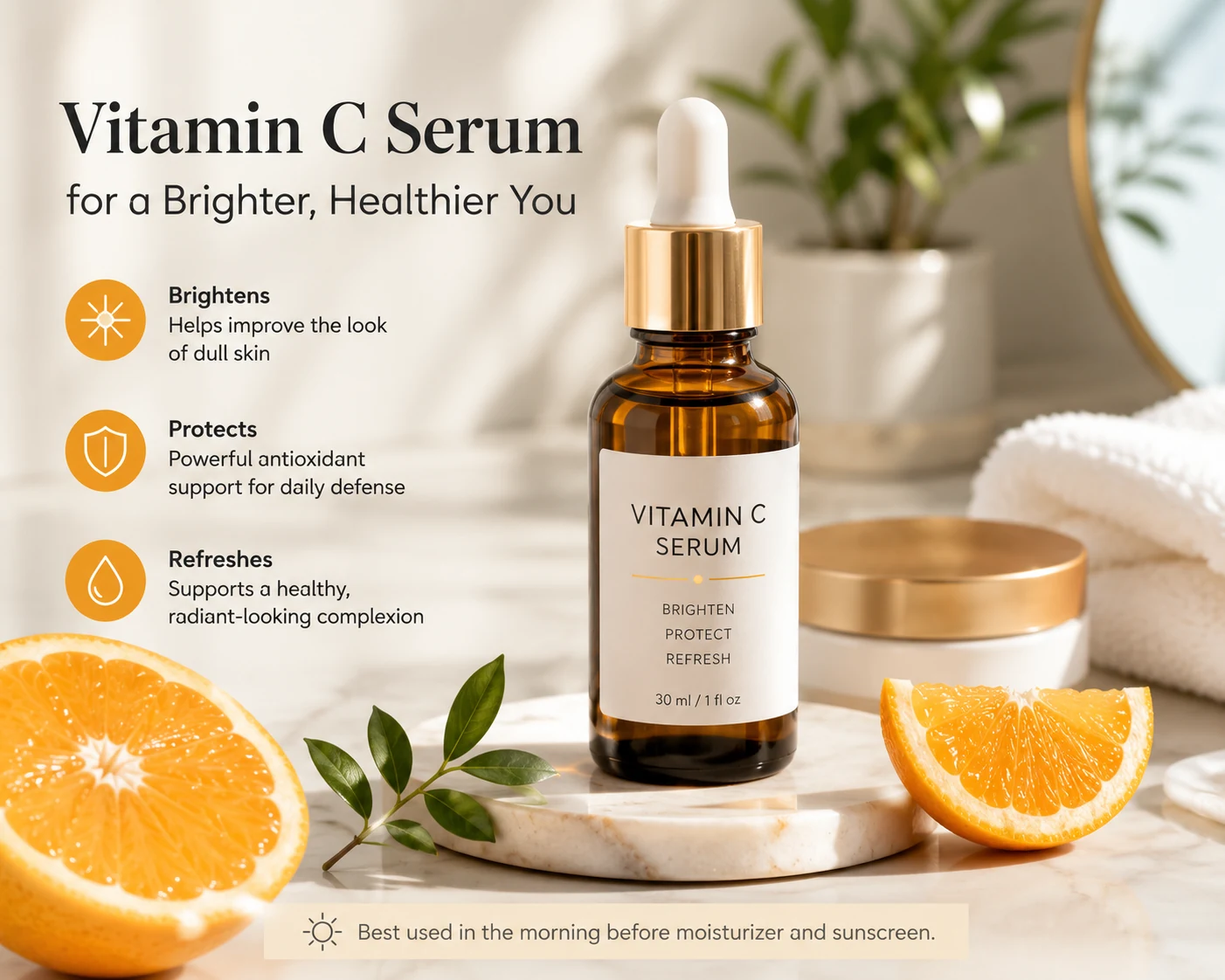
Vitamin C has been one of the most talked-about skincare ingredients for years, and for good reason. Many people first reach for a Vitamin C serum because they want brighter-looking skin, a more even-looking complexion, or extra antioxidant support in their daily routine.
But buying a Vitamin C serum is the easy part.
The questions usually begin after that.
When should I apply it? Should I use it in the morning or at night? How much should I use? Is a higher percentage always better? And why does one Vitamin C serum feel wonderful while another makes the skin feel uncomfortable?
As a licensed esthetician with decades of experience working with different skin types, I have learned that Vitamin C does not need to be complicated. The most important part is choosing a formula that works well with your skin and using it consistently without overwhelming your routine.
What Does Vitamin C Do for the Skin?
Vitamin C is an antioxidant used in skincare to help protect the skin from environmental oxidative stress while supporting a brighter, healthier-looking complexion.
Daily exposure to sunlight, pollution, and other environmental factors can contribute to a dull or tired appearance over time. Antioxidants such as Vitamin C help support the skin as it deals with those everyday environmental stressors.
One of the main reasons people love Vitamin C is its ability to improve the appearance of dullness and uneven-looking skin tone with consistent use.
It is important, however, to keep expectations realistic.
Vitamin C is not an overnight transformation.
Skin usually responds best to a routine that is gentle, consistent, and maintained over time. I would much rather see someone comfortably use an appropriate Vitamin C serum for months than use the strongest product available for several days and stop because their skin becomes irritated.
Not All Vitamin C Serums Are the Same
The words “Vitamin C serum” can describe many different formulas.
L-ascorbic acid is one of the best-known forms of Vitamin C used in skincare. It can be very effective, but it may also feel more stimulating on some skin types and can be less stable when exposed to air, heat, and light.
Other products use Vitamin C derivatives designed to provide greater stability or a gentler skincare experience.
This is one reason two Vitamin C serums can feel completely different even when both products say “Vitamin C” on the label.
When choosing a product, I do not believe everyone needs to search for the highest concentration.
A stronger formula is not automatically a better formula.
Especially for someone who is new to Vitamin C or who has easily reactive skin, a comfortable product used consistently may be a much better choice.
Your skin does not receive an award for tolerating the highest percentage.
When Should You Apply Vitamin C Serum?
For most simple skincare routines, I prefer Vitamin C in the morning.
A basic order can be:
Gentle Cleanser → Vitamin C Serum → Moisturizer → Sunscreen
After cleansing, gently dry the face and apply a small amount of Vitamin C serum evenly over the skin.
Allow it to settle comfortably before applying moisturizer.
The routine does not need ten different steps.
In fact, one of the most common mistakes I see in skincare is adding too many products because we assume more products will produce better results.
A well-selected Vitamin C serum can fit beautifully into a very simple morning routine.
Do You Need Toner First?
Not necessarily.
Some people enjoy using a toner because they like the hydration or the way it makes their skin feel before serum. That is perfectly fine.
But Vitamin C does not require everyone to use toner first.
If your routine is comfortable with cleansing followed directly by Vitamin C serum, moisturizer, and sunscreen, there is no need to add an extra step simply because someone else’s skincare routine includes one.
Skincare should fit your skin, not the other way around.
How Much Vitamin C Serum Should You Use?
More product does not necessarily mean better results.
Usually, a small amount that spreads comfortably over the face is enough. Follow the directions provided with your particular serum because texture and dispensing systems vary.
Applying a large amount can sometimes increase stickiness, pilling under other products, or unnecessary discomfort.
I prefer applying a thin, even layer rather than saturating the skin.
Give the serum a moment to settle before moving on to moisturizer.
There is also no need to wait five or ten minutes between skincare steps unless the product directions specifically tell you to do so.
A practical routine is much easier to maintain.
My Personal Experience
Vitamin C has also been part of my own skincare routine.
I currently use Perricone MD Vitamin C Ester Brightening Serum, and my personal approach to Vitamin C is the same advice I give when discussing skincare with others: I focus more on how my skin responds than on chasing the strongest percentage available.
I like Vitamin C as part of a simple morning routine because it is easy to use consistently.
In my own morning routine, after applying Vitamin C serum, I like to give it a little time to settle before moving on to the next step. When possible, I wait about three minutes before applying my moisturizer. I find that this allows the serum to feel comfortably absorbed and helps the next product layer more smoothly. It is not a strict rule, but it is a small habit that has worked well for me over the years.
Over many years of working in skincare, I have seen people become excited about a powerful new product and begin using too much, too often, too quickly.
Then irritation starts, and they give up on the ingredient completely.
That experience has reinforced something I believe strongly about skincare.
Consistency is more valuable than intensity.
When I introduce or evaluate a skincare product, I pay attention to how the skin feels the next day and over the following weeks, not just immediately after application.
Healthy-looking skin usually comes from what we repeatedly do well.
What If Your Skin Srarts Tingle?
A slight sensation with certain Vitamin C formulas can occur, particularly with some acidic formulas.
But skincare should not feel painfully hot, burning, or increasingly uncomfortable.
If your skin becomes noticeably irritated, stop and allow your skin to recover rather than continuing simply because you believe discomfort means the product is “working.”
If your skin already feels dry, sensitive, or compromised, you may want to focus on supporting your skin barrier before introducing stronger active ingredients.
This is especially important for people who know their skin is sensitive.
If you are new to Vitamin C, you do not necessarily have to begin with daily use.
You might start a few mornings per week and observe how your skin responds.
If everything remains comfortable, the frequency can gradually be increased according to your product directions and your skin’s tolerance.
There is no reason to rush.
Can You Use Vitamin C in the Morning?
Yes. In fact, morning is my preferred time for Vitamin C.
Vitamin C provides antioxidant support, which makes it especially useful as part of a daytime skincare routine.
The American Academy of Dermatology also recommends applying Vitamin C in the morning after cleansing and before sunscreen.
But Vitamin C does not replace sunscreen.
Think of them as serving different purposes in your routine.
Vitamin C can be your antioxidant step, while sunscreen remains your essential daily UV protection step.
After applying Vitamin C and moisturizer, finish your morning routine with a broad-spectrum sunscreen.
Even the most carefully designed brightening routine makes little sense if daily sun protection is ignored.
Vitamin C and Mature Skin
Vitamin C can also be a valuable addition to a mature skincare routine.
As skin changes with age, many people begin noticing that their complexion does not look as bright or even as it once did.
The temptation is often to respond by adding stronger exfoliation or increasingly complicated routines.
That is not always necessary.
For mature skin, I prefer a thoughtful approach: gentle cleansing, a well-tolerated Vitamin C serum, adequate moisturizer, and daily sunscreen.
Simple routines are often underestimated.
The best skincare routine is not the routine with the most products. It is the one your skin tolerates and you can maintain consistently.
How to Keep Vitamin C Serum Fresh
Vitamin C can be sensitive to air, heat, and light, depending on the specific form used in the formula.
Pay attention to how your serum is packaged and stored.
Keep it tightly closed and away from direct sunlight or excessive heat. A bathroom windowsill with strong sunlight is usually not the best place.
Some Vitamin C products gradually change color as they age.
A small variation does not automatically mean a product is unusable because formulas differ, but a dramatic change in color, odor, or texture is a good reason to check the manufacturer’s recommendations and product expiration information.
Buying an enormous bottle is not always a bargain if the formula will sit open for a very long time.
I prefer purchasing an amount that can reasonably be used while the product remains fresh.
Stronger Is Not Always Better
This may be the most important point in this entire article.
Higher concentration does not automatically equal better skin.
People often see percentages on skincare labels and assume that 20% must be twice as effective as 10%.
Skin does not work quite that simply.
Formula stability, the type of Vitamin C, packaging, your overall skincare routine, and—most importantly—your individual skin tolerance all matter.
If a very strong Vitamin C serum leaves your skin uncomfortable and you stop using it after one week, it has very little opportunity to become a useful part of your skincare routine.
A gentler formula that you happily use for months may ultimately be the smarter choice.
A Simple Morning Routine
If you are unsure where to begin, keep it simple.
Step 1: Cleanse gently.
Remove the oil, sweat, and residue that accumulated overnight without leaving the skin feeling stripped.
Step 2: Apply Vitamin C serum.
Use a thin, even layer according to the directions for your particular product.
Step 3: Moisturize.
Choose a moisturizer that keeps your skin comfortable without making the routine unnecessarily heavy.
Step 4: Apply sunscreen.
Finish with broad-spectrum sun protection every morning.
That is enough.
You can always build a more elaborate routine later, but your skin does not require complexity to benefit from good daily habits.
Final Thoughts From an Esthetician
Vitamin C is one of those skincare ingredients that can sound complicated because there are so many formulas, percentages, and opinions surrounding it.
But the basic idea is actually simple.
Choose a Vitamin C formula appropriate for your skin. Introduce it gradually if necessary. Apply it consistently. Keep your morning routine comfortable. And always finish with sunscreen.
After decades in the beauty and skincare industry, I have become less impressed by routines built around the strongest product and more impressed by routines people can realistically maintain.
Vitamin C is no exception.
Do not judge your routine by how powerful it feels on the first day.
Judge it by how comfortable your skin feels and how consistently you can care for it over time.
Beautiful, healthy-looking skin is rarely the result of one dramatic step.
More often, it is the result of small, thoughtful choices repeated every day.
This article is written from the perspective of a licensed esthetician and is intended for general cosmetic skincare education. It is not medical advice. If you experience persistent burning, swelling, significant irritation, or another concerning skin reaction, discontinue the product and consult a dermatologist or other qualified medical professional.
Leave a Reply