
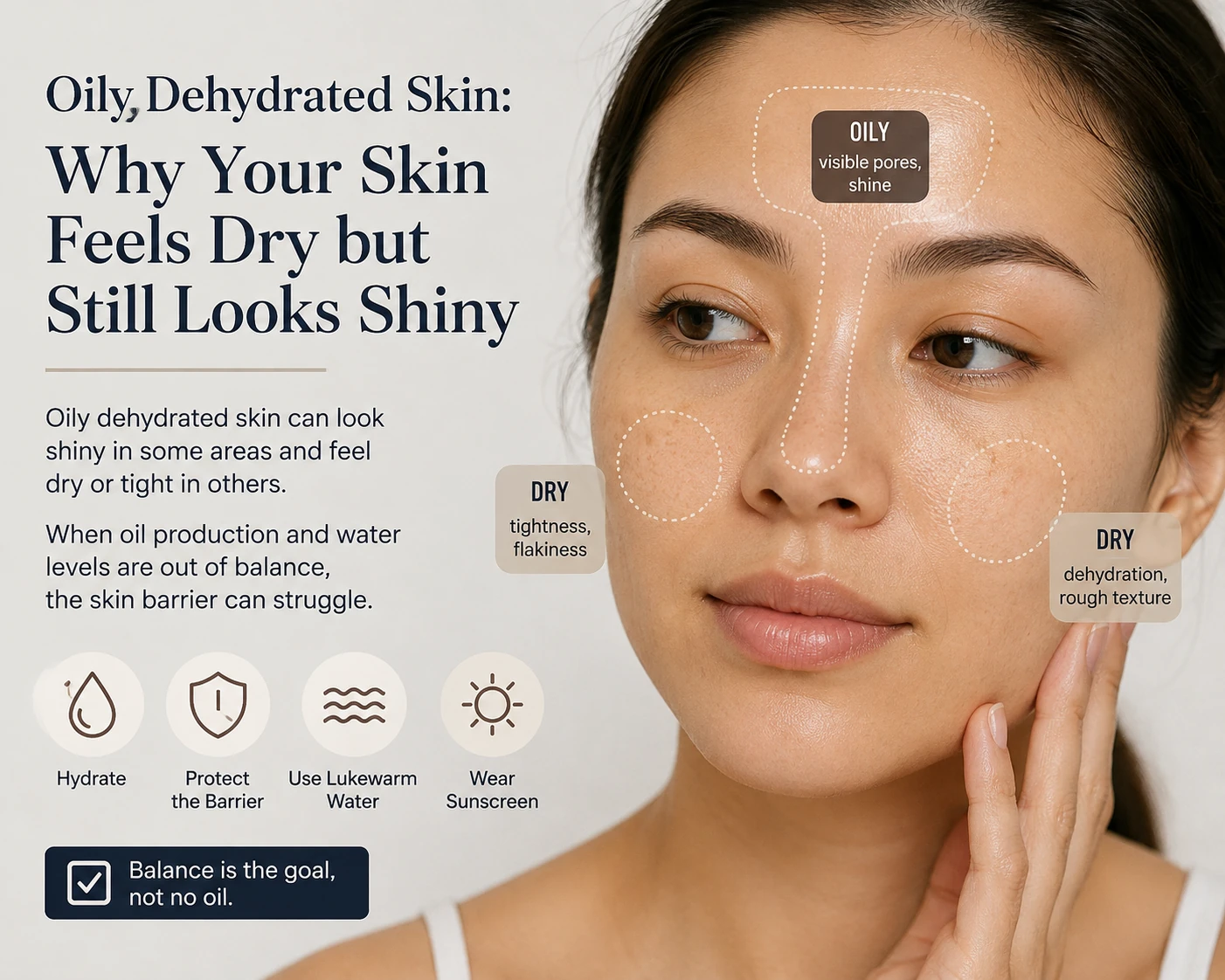
Oily dehydrated skin can be confusing because the skin may look shiny in one area while feeling tight, rough, or dry in another.
As an esthetician, I often see this combination in clients who assume they simply have “combination skin.” But sometimes the issue is not only where the oil appears. It is also about how much water the skin is holding and how well the skin barrier is functioning.
One of my clients in her 30s is a good example. She has a small face, but the difference between areas is very noticeable. Her T-zone tends to be oily, and her pores look more visible there. At the same time, her cheeks and other areas feel much drier.
She also loves taking very hot showers.
That habit may feel relaxing, but very hot water can leave already-dry areas feeling tighter and more uncomfortable. Over time, this can make the contrast between an oily T-zone and dehydrated areas feel even more obvious.
This is why I like to explain that oil and water are not the same thing.
Skin can produce plenty of oil and still be lacking water.
Understanding that difference is the first step toward caring for oily dehydrated skin without over-cleansing, over-exfoliating, or making the dry areas feel even worse.
Oily Skin and Dehydrated Skin Are Not the Same Thing
One of the most important things to understand about oily dehydrated skin is that oiliness and dehydration describe two different things.
Oiliness is related to how much sebum the skin produces. Dehydration, on the other hand, means the skin is lacking water.
That is why someone can have an oily T-zone and still feel tight, dry, or uncomfortable in other areas.
Oily Skin Is a Skin Type
Oily skin naturally produces more sebum. This can make the forehead, nose, and chin look shiny, and pores may appear more noticeable in those areas.
Dehydration Is a Skin Condition
Dehydration can happen to any skin type, including oily skin. It may make the skin feel tight, dull, rough, or less comfortable.
This is why I often remind clients that oily skin does not automatically mean well-hydrated skin.
In fact, when people see shine, they sometimes try to remove more oil by cleansing too often or using strong exfoliating products. That can leave the skin feeling even more dehydrated.
For oily dehydrated skin, the goal is not to eliminate all oil. The goal is to keep the skin clean while also supporting hydration and the skin barrier.
Why Very Hot Water Can Make the Dry Areas Feel Worse
Very hot water can feel soothing, especially during a long shower, but the skin may not enjoy it as much as we do.
When water is too hot, it can strip away some of the natural lipids and surface oils that help the skin hold onto moisture. For someone who already has dry or dehydrated areas, this can leave the skin feeling tighter, rougher, or more uncomfortable after bathing.
This is something I notice with the client I mentioned earlier.
Her T-zone is naturally oilier and her pores are more visible there, while the rest of her face is much drier. Because she prefers very hot showers, the dry areas can feel even more pronounced.
The important point is that hot water does not necessarily make the T-zone less oily. Instead, it can make the contrast between oily and dry areas feel stronger.
For oily dehydrated skin, lukewarm water is usually a better choice.
It cleanses the skin without creating as much unnecessary dryness, and it helps preserve the comfort of the skin barrier.
Why Enlarged-Looking Pores Often Stand Out More in the T-Zone
In oily dehydrated skin, the T-zone often looks very different from the cheeks.
The forehead, nose, and chin usually contain more sebaceous glands, so these areas naturally tend to produce more oil. When oil mixes with dead skin cells and surface debris, pores can look more noticeable.
This is exactly what I see with my client in her 30s. Her T-zone has a much oilier appearance, and the pores in that area look more enlarged, while the surrounding areas of her face feel dry.
I prefer to say that the pores look more visible rather than saying they have simply “opened.” Pores do not open and close like doors, but their appearance can become more noticeable depending on oil production, congestion, skin texture, and hydration.
Interestingly, dehydration can sometimes make texture look more obvious too. When the skin surface is dry or lacking water, fine lines and uneven texture may stand out more.
This is why treating only the oily T-zone is not enough.
A balanced routine should help keep excess oil under control while also improving hydration in the drier areas.
Common Signs of Oily Dehydrated Skin
Oily dehydrated skin can show several signs at the same time, which is why it is often misunderstood.
You may notice shine across the forehead, nose, or chin while the cheeks feel tight or rough. The skin may look oily soon after cleansing, yet still feel uncomfortable underneath.
Other common signs can include:
- More visible pores in the T-zone
- Dry or flaky areas around the cheeks or mouth
- Tightness after cleansing
- Dull-looking skin despite surface oil
- Makeup that separates in oily areas but clings to dry patches
- Skin that feels both greasy and thirsty at the same time
This combination can make people want to treat each problem aggressively, but that usually creates more imbalance.
The oily areas do not need to be stripped, and the dry areas do not necessarily need a very heavy cream.
The goal is to create a routine that gently manages oil while giving the skin enough hydration and barrier support to feel more balanced.
Why Over-Cleansing Can Make Oily Dehydrated Skin Harder to Manage
When the T-zone looks shiny, many people instinctively want to cleanse more often or use a stronger cleanser.
But with oily dehydrated skin, that approach can backfire.
If cleansing removes too much of the skin’s natural protective lipids, the dry areas may feel even tighter and more uncomfortable. At the same time, the oily areas can still continue producing sebum, so the face may end up feeling both stripped and shiny.
I often see this pattern when clients focus only on controlling oil.
A harsh foaming cleanser, very hot water, frequent exfoliation, and repeated cleansing can make the skin feel temporarily “clean,” but that squeaky-clean feeling is not always a good sign.
For this type of skin, I usually prefer a gentler approach:
- Use lukewarm water instead of very hot water
- Choose a mild cleanser that does not leave the skin tight
- Avoid scrubbing the dry areas
- Do not exfoliate aggressively just because the T-zone looks oily
- Follow cleansing with hydration rather than trying to remove every trace of oil
The goal is not to make the entire face behave exactly the same.
It is to respect the fact that different areas of the same face can have different needs.
How to Hydrate Oily Skin Without Making It Feel Heavy
One of the biggest mistakes people make with oily dehydrated skin is avoiding moisturizer because they are afraid of looking shinier.
But hydration does not have to mean using a thick or greasy cream.
For this type of skin, I usually prefer lightweight layers that add water and comfort without overwhelming the T-zone.
Ingredients such as hyaluronic acid, glycerin, panthenol, and niacinamide can be helpful in a simple routine. A lightweight serum or gel-cream moisturizer may be enough for some people, while drier areas can sometimes benefit from a little more moisturizer.
This is also where applying products by area can make sense.
For example, the T-zone may only need a light layer, while the cheeks may need a little more support. You do not always have to use the exact same amount of product everywhere on the face.
I also like to remind clients to apply hydrating products while the skin is still slightly damp after cleansing. This can help the skin feel more comfortable and reduce that tight, thirsty feeling.
The goal is not to make oily skin feel coated.
It is to give dehydrated skin enough water and barrier support so the whole face can feel more balanced.
A Simple Routine for Oily Dehydrated Skin
When the skin is oily in some areas and dry in others, a complicated routine is usually not necessary.
I prefer to keep the basic routine balanced and gentle.
In the morning, cleanse lightly if needed, then use a hydrating toner or serum followed by a lightweight moisturizer and sunscreen.
In the evening, use a gentle cleanser with lukewarm water, then apply hydration while the skin is still slightly damp. Follow with a moisturizer that feels comfortable without making the T-zone feel overly heavy.
If the cheeks are much drier than the center of the face, you can apply a little more moisturizer to those areas.
For the T-zone, keep the layers lighter and avoid using strong oil-control products every day unless the skin truly tolerates them well.
A simple routine might look like this:
- Gentle cleanser
- Hydrating toner or serum
- Lightweight moisturizer
- Sunscreen in the morning
- Optional targeted exfoliation only when needed
For oily dehydrated skin, consistency usually works better than constantly changing products.
The goal is to help the oily areas feel less congested while keeping the dry areas comfortable and supported.
Esthetician Tip: Treat Different Areas Differently
One of the most useful things I teach clients with oily dehydrated skin is that the entire face does not always need the exact same treatment.
If the T-zone is oily and the cheeks are dry, it can make sense to adjust the amount and texture of products by area.
For example, the forehead, nose, and chin may do well with lighter layers, while the cheeks may need a little more moisturizer or barrier support.
This does not mean you need a completely different routine for every part of your face.
It simply means paying attention to what each area is telling you.
With my client in her 30s, the contrast is very clear. Her oily T-zone and more visible pores need a gentle, non-stripping approach, while the drier areas need more hydration and protection from habits like very hot showers.
This is why I prefer balance over aggressive oil control.
When you stop trying to make every area of the face feel exactly the same, skincare often becomes much more effective and comfortable.
Final Thoughts
Oily dehydrated skin can be frustrating because the skin may look shiny and still feel dry at the same time.
That does not mean the skin is contradictory. It simply means oil production and water content are two different parts of skin function.
For some people, the imbalance is especially obvious in the T-zone. The forehead, nose, and chin may look oilier and show more visible pores, while the cheeks feel dry, tight, or rough.
Habits like very hot showers, over-cleansing, and aggressive exfoliation can make the dry areas feel worse without necessarily solving the oiliness.
A better approach is usually more balanced: gentle cleansing, lukewarm water, lightweight hydration, appropriate moisturizer, and sunscreen.
Most importantly, pay attention to how different areas of your face behave instead of forcing one solution onto the entire face.
Healthy-looking skin is not about eliminating every bit of oil. It is about helping the skin feel comfortable, hydrated, and supported.
Frequently Asked Questions
Can oily skin really be dehydrated?
Yes. Oil and water are different. The skin can produce plenty of sebum while still lacking water, which is why it may look shiny but feel tight or dry.
Is oily dehydrated skin the same as combination skin?
Not exactly. Combination skin usually describes a skin type with oilier and drier areas. Dehydration is a skin condition that can happen on top of any skin type, including combination or oily skin.
Should I skip moisturizer if my T-zone is oily?
Usually, no. A lightweight moisturizer can help support hydration without making the skin feel heavy. You can also apply a little more product to the drier areas and less to the T-zone.
Can hot showers make dehydrated skin feel worse?
Yes. Very hot water can remove some of the skin’s protective surface lipids and leave dry or dehydrated areas feeling tighter and more uncomfortable.
Should I exfoliate more if my pores look large?
Not necessarily. Over-exfoliating can irritate the skin and make dehydration worse. Gentle, targeted exfoliation may help some people, but it should not be used aggressively just because pores look more visible.
Leave a Reply