
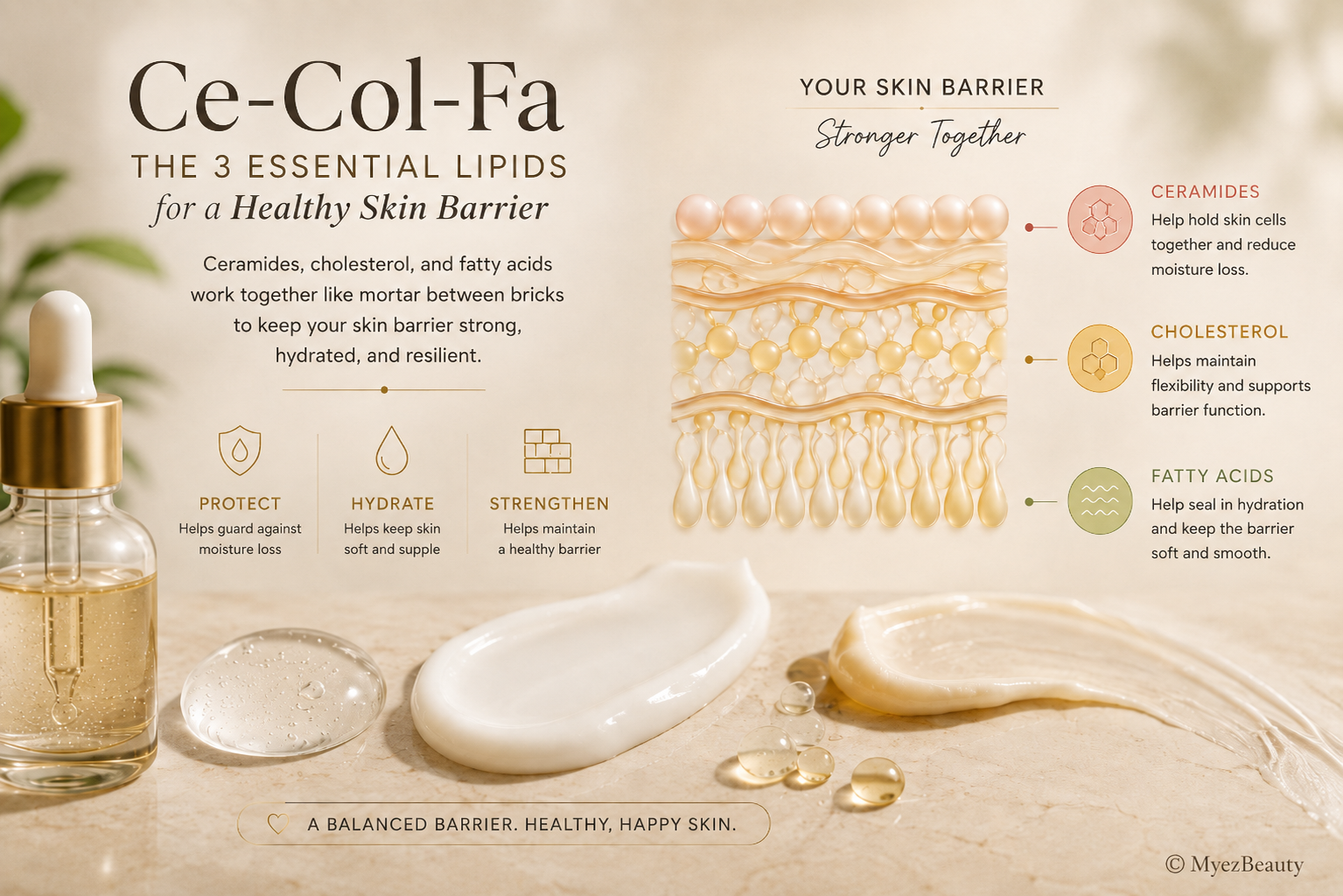
Ceramides, cholesterol, and fatty acids are three essential skin-identical lipids that help form and maintain the skin’s natural moisture barrier. Together, they support a smoother, stronger, and more resilient skin barrier.
At MyezBeauty, I like to call this combination Ce-Col-Fa — short for ceramides, cholesterol, and fatty acids. These three lipids work best as a team, especially when the skin feels dry, tight, sensitive, or easily irritated.
What Are Skin Barrier Lipids?
The outermost layer of the skin contains natural skin barrier lipids that help hold skin cells together and reduce moisture loss. Among these lipids, three are especially important: ceramides, cholesterol, and fatty acids.
Think of the skin barrier like a brick wall. The skin cells are the bricks, while these lipids act like the mortar that helps keep everything sealed together.
When the balance of these lipids is disrupted, the skin may feel dry, tight, rough, or more sensitive than usual. Supporting the skin with products that contain skin-identical lipids can help maintain a healthier-looking barrier.
If your skin barrier feels compromised, you may also want to read my complete guide to skin barrier repair.
This is why I like to remember the three key lipids as the Ce-Col-Fa trio: ceramides, cholesterol, and fatty acids.
Ceramides and Skin Barrier Lipids
Ceramides are naturally occurring lipids found in the outermost layer of the skin. They play an important role in helping the skin retain moisture and maintain a strong protective barrier.
When ceramide levels are low, the skin may feel dry, rough, tight, or more sensitive to environmental stress. This is why ceramides are commonly used in barrier-supporting serums, lotions, and moisturizers.
In skincare, ceramides work especially well when they are combined with other skin-identical lipids, including cholesterol and fatty acids. Together, these three lipids help support the structure of the skin barrier more effectively than focusing on ceramides alone.
This is the first part of the Ce-Col-Fa trio.
Cholesterol — Helps Keep the Barrier Flexible
Cholesterol is another important lipid naturally found in the skin barrier. While ceramides help provide structure, cholesterol helps support the flexibility and overall balance of the outer skin layer.
In skincare, cholesterol is often included in barrier-repair moisturizers together with ceramides and fatty acids. This combination helps replenish the types of lipids naturally present in healthy skin.
For dry, mature, or barrier-compromised skin, products containing cholesterol can be especially helpful when the skin feels tight or less resilient.
Cholesterol is the second part of the Ce-Col-Fa trio, working alongside ceramides and fatty acids to support a stronger, more comfortable skin barrier.
Fatty Acids — Support Moisture and Barrier Function
Fatty acids are another essential part of the skin’s natural lipid barrier. They help support the outer layer of the skin and play an important role in keeping moisture from escaping too quickly.
When the skin does not have enough of these protective lipids, it may feel dry, rough, or less comfortable. Fatty acids in skincare can help support a smoother, more balanced barrier, especially when they are paired with ceramides and cholesterol.
You may see fatty acids in moisturizers listed as ingredients such as linoleic acid, stearic acid, or palmitic acid.
Fatty acids complete the Ce-Col-Fa trio, giving us the three key skin barrier lipids: ceramides, cholesterol, and fatty acids.
Why These Skin Barrier Lipids Work Better Together
Ceramides, cholesterol, and fatty acids each have an important role in the skin barrier, but they are especially useful when they are present together.
Ceramides help support barrier structure, cholesterol helps maintain flexibility, and fatty acids help support moisture retention and overall barrier function.
That is why many well-formulated barrier creams combine all three instead of relying on ceramides alone.
I like to think of them as a team: one ingredient does not replace the others. Together, the Ce-Col-Fa trio helps support a healthier-looking, more resilient skin barrier.
For dry, mature, dehydrated, or environmentally stressed skin, choosing a moisturizer with all three lipids can be a simple way to give the barrier more complete support.
Why I Reach for Ce-Col-Fa After a Day of Golf
After a long day of golf, my skin has usually been exposed to sun, heat, wind, and sweat for several hours. On those evenings, I like to keep my skincare routine simple and focus on barrier support.
After cleansing, I usually apply a lightweight hydrating toner or serum first. Then I finish with a moisturizer containing Ce-Col-Fa — ceramides, cholesterol, and fatty acids.
These three skin-identical lipids help support the skin’s natural moisture barrier and can help relieve the dry, tight feeling that sometimes follows prolonged outdoor exposure.
If my skin feels especially warm or uncomfortable, I may also use a soothing product with ingredients such as centella asiatica, madecassoside, or panthenol before applying my barrier moisturizer.
For me, finishing the day with Ce-Col-Fa is a simple and reliable way to give my skin extra barrier support after spending hours outdoors.
How to Choose a Ce-Col-Fa Serum or Moisturizer
When shopping for barrier-supporting skincare, look beyond the word “ceramide” on the front label. A more complete formula may combine ceramides, cholesterol, and fatty acids in the same product.
For a lighter routine, a barrier serum or lightweight lotion can work well, especially for combination or oily skin. If your skin feels dry, mature, or easily tight, a richer barrier cream or triple-lipid moisturizer may feel more comfortable.
You can also look for supportive ingredients such as panthenol, hyaluronic acid, glycerin, centella asiatica, or madecassoside. These ingredients can complement Ce-Col-Fa by adding hydration or soothing support.
The goal is not necessarily to choose the heaviest product. Instead, choose a texture that matches your skin type while still providing the lipids your barrier needs.
Serum and Moisturizer Types to Look For
You do not need a complicated routine to support the skin barrier. The most important step is choosing products that fit your skin type and contain ingredients that help replenish or support the skin’s natural lipids.
Serum Types
A ceramide serum can be a good choice when you want lightweight barrier support without using a heavy cream.
A barrier-repair serum may combine ceramides with cholesterol, fatty acids, panthenol, or other supportive ingredients.
For dehydrated skin, a ceramide and hyaluronic acid serum can provide both hydration and barrier support.
If the skin feels easily irritated or uncomfortable, a ceramide and panthenol serum or a soothing serum with centella asiatica or madecassoside can also fit well into the routine.
Moisturizer Types
A ceramide cream is a simple option for dry or barrier-compromised skin.
A triple-lipid moisturizer is especially interesting because it contains the full Ce-Col-Fa trio — ceramides, cholesterol, and fatty acids.
A barrier-repair cream may also include humectants and soothing ingredients alongside these lipids.
For oily or combination skin, a lightweight barrier lotion or gel-cream may provide enough support without feeling too rich.
The best product is not always the richest one. Texture, skin type, climate, and the condition of your skin barrier should all be considered when choosing between a serum, lotion, gel-cream, or cream.
Some barrier creams and triple-lipid moisturizers may feel thicker than a regular lotion. Apply a small amount and spread it evenly over the skin rather than using too much at once. A thin, even layer is usually enough to provide comfortable barrier support without making the skin feel overly heavy.
How and When to Apply Skin Barrier Lipids
Ce-Col-Fa products are usually easiest to use toward the end of your skincare routine, after cleansing and applying lighter hydrating products.
Start with a gentle cleanser, then apply a toner or lightweight serum if you use one. Follow with your Ce-Col-Fa moisturizer to help seal in hydration and support the skin barrier.
If you use both a barrier serum and a moisturizer, apply the serum first and the moisturizer afterward.
For very dry skin, Ce-Col-Fa can be used both morning and evening. During the day, always finish with a broad-spectrum sunscreen, especially if you will be spending time outdoors.
At night, a Ce-Col-Fa moisturizer can be especially helpful after days when the skin has been exposed to wind, sun, air conditioning, or other drying environmental conditions.
Who Can Benefit Most from Skin Barrier Lipids?
Ce-Col-Fa can be useful for many skin types, but it may be especially helpful when the skin barrier feels dry, tight, rough, or easily uncomfortable.
People with dry or mature skin may appreciate richer creams containing ceramides, cholesterol, and fatty acids because these lipids help support moisture retention and barrier comfort.
Those with combination or oily skin can also benefit from Ce-Col-Fa. The key is choosing a lightweight lotion, serum, or gel-cream rather than assuming barrier care always needs to be heavy.
Ce-Col-Fa may also be helpful after periods of environmental stress, such as prolonged sun exposure, cold weather, wind, frequent cleansing, or time spent in dry indoor air.
The goal is not to “fix” the skin overnight, but to consistently support the natural barrier so the skin can stay more comfortable, balanced, and resilient.
Frequently Asked Questions About Skin Barrier Lipids
What does Ce-Col-Fa mean?
Ce-Col-Fa is a simple name I use for the three key skin barrier lipids: ceramides, cholesterol, and fatty acids. These lipids naturally exist in the skin and work together to support the moisture barrier.
Is Ce-Col-Fa only for dry skin?
No. Dry and mature skin may especially benefit from richer lipid-based creams, but combination and oily skin can also use Ce-Col-Fa products. The key is choosing a lighter serum, lotion, or gel-cream texture if heavier creams feel uncomfortable.
Can I use Ce-Col-Fa every day?
Yes. In most skincare routines, products containing ceramides, cholesterol, and fatty acids can be used daily. They are commonly used after hydrating serums and before sunscreen in the morning, or as the final moisturizing step at night.
Can I use Ce-Col-Fa after being outdoors?
Yes. I personally like using Ce-Col-Fa after long outdoor days, including golf, when my skin has been exposed to sun, wind, heat, and sweat. After gentle cleansing and hydration, a barrier-supporting moisturizer can help the skin feel more comfortable.
Is a Ce-Col-Fa serum enough, or do I still need moisturizer?
A serum can provide lightweight barrier support, but if your skin feels dry or tight, following it with a moisturizer may be more comfortable. Your skin type, climate, and the condition of your skin barrier should guide how many layers you need.
Final Thoughts
Healthy skin is not only about adding more products. It is also about supporting the natural structure that helps keep moisture in and environmental stress out.
Ceramides, cholesterol, and fatty acids are three important lipids that work together within the skin barrier. That is why I like to think of them as the Ce-Col-Fa trio.
Whether you choose a lightweight barrier serum, a lotion, or a richer triple-lipid moisturizer, the goal is the same: give the skin consistent support without making the routine unnecessarily complicated.
For me, Ce-Col-Fa has also become one of my favorite ways to finish my evening routine after a long day outdoors, especially after golf.
As an esthetician, I always recommend paying attention to how your skin feels and choosing textures that suit your skin type. If dryness, irritation, pain, or other concerning skin changes persist, consider speaking with a dermatologist or other qualified medical professional.
Leave a Reply