
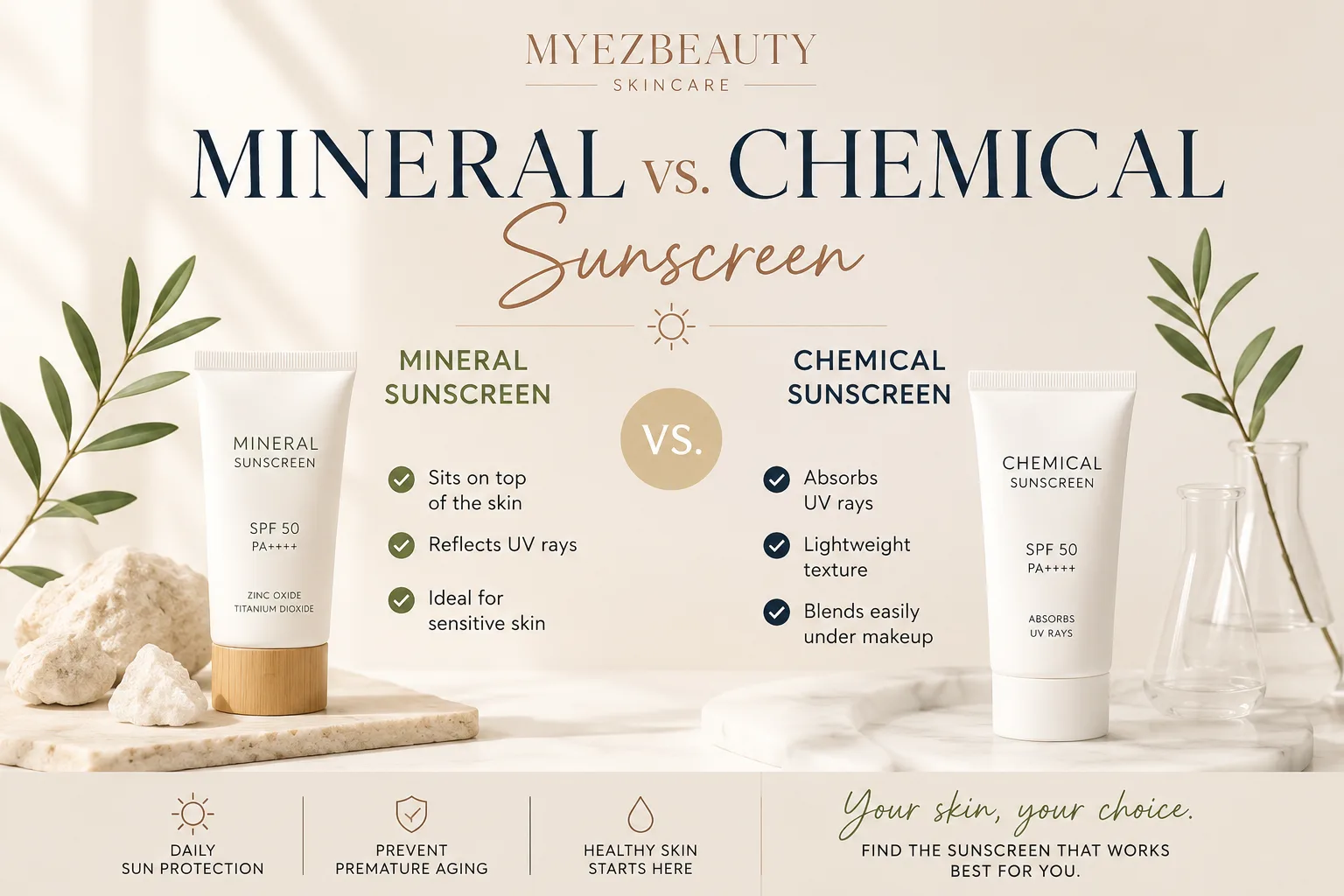
Mineral vs chemical sunscreen is one of the most common questions people ask when choosing daily sun protection. Sunscreen is an essential part of a healthy skincare routine, but choosing the right formula can feel surprisingly complicated. Which type is better for sensitive, dry, oily, or mature skin?
As an esthetician, I believe the best sunscreen is not simply the one with the highest SPF or the most popular ingredients. It is the sunscreen that works well with your skin and that you feel comfortable using consistently every day.
Both mineral and chemical sunscreens can provide effective sun protection when used correctly, but they differ in their UV-filter ingredients, formulation, texture, and how they may feel on different skin types.
In this guide, we’ll look at the differences between mineral and chemical sunscreen, their advantages and limitations, and how to choose the right sunscreen for your skin. Most importantly, we’ll discuss how to use sunscreen properly as part of a simple, effective daily skincare,
Mineral vs. Chemical Sunscreen: What Is Mineral Sunscreen?
Mineral sunscreen, sometimes called physical sunscreen, uses mineral UV filters—most commonly zinc oxide and titanium dioxide—to protect the skin from ultraviolet radiation.
You may have heard that mineral sunscreen works only by sitting on top of the skin and reflecting UV rays like a shield. That explanation is common, but it is not completely accurate. Mineral UV filters protect the skin largely by absorbing UV radiation, while also scattering and reflecting some of it.
One reason I often consider mineral sunscreen for sensitive skin is its relatively simple approach to UV protection. Zinc oxide, in particular, provides broad-spectrum protection against both UVA and UVB rays.
Benefits of Mineral Sunscreen
Mineral sunscreen may be a good choice for people with sensitive or easily irritated skin, depending on the complete formula. Many modern mineral sunscreens are also designed to feel lighter and blend more easily than the thick, chalky formulas people may remember from years ago.
However, mineral sunscreen can still leave a white cast, particularly on deeper skin tones, and some formulas may feel heavier or drier on the skin. This is why choosing sunscreen should never be based on the UV filter alone—the overall formulation and how it feels on your individual skin matter too.
Mineral vs. Chemical Sunscreen: What Is Chemical Sunscreen?
Chemical sunscreen uses organic UV filters that absorb ultraviolet radiation and convert that energy into a small amount of heat, which is then released from the skin.
Depending on the country and formulation, chemical sunscreens may contain UV filters such as avobenzone, octisalate, octocrylene, or homosalate. Some sunscreens sold outside the United States may also use newer-generation UV filters that are not currently approved for use in U.S. sunscreen products.
One of the biggest advantages of chemical sunscreen is its lightweight and cosmetically elegant texture. Many formulas spread easily, absorb without leaving a noticeable white cast, and work comfortably underneath makeup.
Why Some People Prefer Chemical Sunscreen
If you have oily or combination skin, or simply dislike the heavier feeling of some mineral sunscreens, a chemical sunscreen may be easier to wear every day.
Chemical formulas can also be especially appealing for people with deeper skin tones because they are generally less likely to leave the visible white or gray cast sometimes associated with mineral sunscreens.
However, the best choice still depends on the entire formulation. Some people with sensitive skin may find certain sunscreen formulas irritating, while others can use them comfortably without any problems.
This is why I encourage my clients to pay attention not only to whether a sunscreen is labeled mineral or chemical, but also to how their skin actually responds to the complete product.
Mineral vs. Chemical Sunscreen: What’s the Difference?
The biggest difference between mineral and chemical sunscreen is the type of UV filters used in the formula.
Mineral sunscreens use filters such as zinc oxide and titanium dioxide, while chemical sunscreens use organic UV filters such as avobenzone, octisalate, octocrylene, and homosalate in products sold in the United States.
But when choosing between mineral and chemical sunscreen, the ingredient category is only part of the story. Texture, skin sensitivity, skin tone, lifestyle, and—most importantly—whether you will actually wear the sunscreen consistently all matter.
Mineral Sunscreen May Be Better If You:
- Have sensitive or easily irritated skin
- Prefer mineral UV filters
- Don’t mind a slightly richer texture
- Find a mineral formula that blends comfortably with your skin tone
Chemical Sunscreen May Be Better If You:
- Prefer a lightweight, invisible finish
- Wear sunscreen underneath makeup
- Have oily or combination skin and prefer lighter textures
- Want to minimize the possibility of a visible white cast
Neither type is automatically “better” for everyone. The best sunscreen is one that provides broad-spectrum protection, has an SPF appropriate for daily use, and is comfortable enough that you will apply it consistently and generously.
As an esthetician, this is the point I emphasize most: a beautifully formulated sunscreen that you enjoy wearing every day is often more useful in real life than a product you avoid because it feels uncomfortable on your skin.
Which Sunscreen Is Best for Your Skin Type?
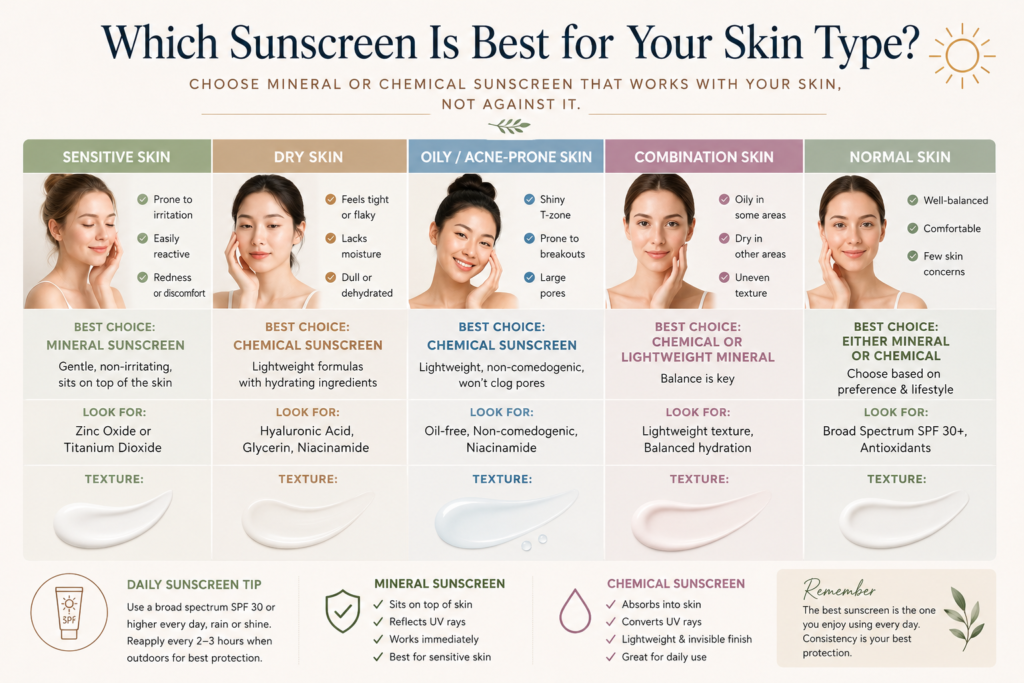
Your skin type can help guide your sunscreen choice, but there is no single formula that works perfectly for everyone. The texture, moisturizing ingredients, finish, and overall formulation can be just as important as whether the sunscreen is mineral or chemical.
For Dry Skin
Dry skin often feels more comfortable with a sunscreen that includes moisturizing ingredients and has a creamier texture.
Look for formulas containing ingredients such as glycerin, hyaluronic acid, ceramides, or squalane. Both mineral and chemical sunscreens can work well for dry skin, so focus on a formula that leaves your skin feeling comfortable rather than tight or flaky.
For Oily or Combination Skin
If your skin becomes oily throughout the day, lightweight fluid, gel, or lotion textures may feel more comfortable.
Chemical sunscreens are often available in very lightweight formulations, but there are also excellent mineral options designed for oily skin. Look for terms such as lightweight, non-comedogenic, or oil-free when appropriate for your needs.
For Sensitive Skin
For sensitive or easily irritated skin, I often recommend starting with a fragrance-free mineral sunscreen containing zinc oxide and/or titanium dioxide.
However, “mineral” does not automatically mean irritation-free. Always consider the entire ingredient list and how your individual skin responds to the product.
For Mature Skin
For mature skin, sun protection is one of the most important steps in maintaining healthy-looking skin.
I generally prefer formulas that combine broad-spectrum sun protection with comfortable hydration. A sunscreen that sits smoothly on the skin without emphasizing dryness can work especially well under makeup.
And remember: sunscreen is not only about preventing visible signs of aging. Consistent UV protection helps protect the skin from cumulative sun damage over time.
SPF 30 vs. SPF 50: Which Should You Choose?
SPF, or Sun Protection Factor, primarily measures how well a sunscreen protects the skin from UVB radiation, the type of ultraviolet radiation most closely associated with sunburn.
For everyday use, I recommend choosing a broad-spectrum sunscreen with SPF 30 or higher. Broad-spectrum protection is important because it helps protect the skin from both UVA and UVB radiation.
SPF 50 provides more UVB protection than SPF 30, but a higher SPF does not mean you can apply less sunscreen or stay in the sun indefinitely. Proper application and reapplication are still essential.
How Much Sunscreen Should You Apply?
One of the most common sunscreen mistakes is simply not applying enough.
Apply sunscreen generously to all exposed skin. For the face and neck, use enough product to create an even, complete layer rather than trying to stretch a tiny amount across the skin.
If you are spending time outdoors, remember areas that are easy to miss, including the ears, hairline, neck, chest, and backs of the hands.
When Should You Reapply Sunscreen?
For outdoor exposure, sunscreen should generally be reapplied about every two hours, and sooner after swimming or sweating, according to the directions on the product.
If you are swimming or exercising, choose a sunscreen labeled water resistant and check whether the label specifies 40 or 80 minutes of water resistance.
And one point I always want people to remember:
Sunscreen should be the final step of your morning skincare routine before makeup.
Your moisturizer goes first, followed by sunscreen. Give the sunscreen time to settle comfortably on the skin, and then apply makeup.
Common Sunscreen Mistakes I See as an Esthetician
Even the best sunscreen cannot provide the protection you expect if it is not used correctly. Over the years, I have seen many people invest in excellent skincare products while overlooking some of the simplest sunscreen habits.
1. Applying Too Little Sunscreen
One of the most common mistakes is using only a very small amount of sunscreen, especially on the face.
Sunscreen needs to be applied generously and evenly to exposed skin. Don’t forget areas such as the ears, neck, hairline, chest, and backs of the hands.
2. Wearing Sunscreen Only on Sunny Days
UV exposure does not disappear simply because the sky is cloudy.
For me, sunscreen is not a special product reserved for the beach or summer vacation. It is part of a consistent morning skincare routine.
Making sun protection a daily habit is much easier than trying to compensate for years of accumulated sun exposure later.
3. Relying on SPF in Makeup Alone
Foundation, cushion compacts, and other makeup products may contain SPF, but most people do not apply enough makeup to achieve the level of protection stated on the label.
I prefer using a dedicated sunscreen first and thinking of SPF-containing makeup as an additional layer—not the foundation of your sun-protection routine.
4. Forgetting to Reapply
Applying sunscreen in the morning does not necessarily mean you are protected for the entire day.
If you are outdoors for extended periods, especially while swimming, exercising, or sweating, reapplication becomes important. Follow the directions on your sunscreen and reapply as needed.
5. Choosing Sunscreen Only by the SPF Number
A higher SPF number does not automatically make a sunscreen the best choice for your skin.
A sunscreen also needs to fit comfortably into your routine. If it feels too greasy, too drying, leaves a cast you dislike, or does not work well with your makeup, you may be less likely to use enough of it consistently.
Consistency matters. The sunscreen you are willing to use correctly every day is often the sunscreen that serves you best.
Can You Use Mineral and Chemical Sunscreen Together?
Yes. Some sunscreen formulations combine different types of UV filters, and you may also encounter products marketed as hybrid sunscreens.
However, you do not need to layer a mineral sunscreen over a chemical sunscreen simply to get “better” protection. What matters more is choosing a broad-spectrum sunscreen with SPF 30 or higher and applying it generously and evenly.
Layering multiple sunscreens can also make your routine unnecessarily complicated. Depending on the formulas, layering may cause pilling, uneven application, or an uncomfortable finish under makeup.
My Esthetician Tip
I prefer to keep sun protection simple.
Choose one sunscreen that works well with your skin type, feels comfortable, and fits naturally into your morning routine. Apply it properly and make daily use a habit.
If you have sensitive skin, pay attention to how your skin responds—not just to whether the label says “mineral” or “chemical.” If you have dry or mature skin, consider the overall moisturizing qualities of the formula. And if you have oily skin, a lightweight texture that you genuinely enjoy wearing may make daily sunscreen use much easier.
The goal is not to find the “perfect” sunscreen. The goal is to find effective sun protection that you will actually use every day.
Mineral vs. Chemical Sunscreen: The Final Verdict
So, when comparing mineral vs chemical sunscreen, which one is better for your skin?
The answer depends on your skin, your preferences, and the formula you are most comfortable using consistently.
Mineral sunscreen can be an excellent option for sensitive skin and for those who prefer zinc oxide or titanium dioxide. Chemical sunscreen may be a better fit for people who prefer lightweight textures, an invisible finish, or sunscreen that layers easily under makeup.
Neither category is universally better than the other.
What matters most is choosing a broad-spectrum sunscreen with SPF 30 or higher, applying it generously, and making sun protection part of your daily routine.
Healthy skin is not created by one miracle ingredient or one perfect product. It comes from consistent habits: gentle cleansing, proper hydration, supporting the skin barrier, and protecting the skin from unnecessary UV exposure.
That is why sun protection is one of the three essential principles I emphasize in my approach to healthy skin: cleanse, hydrate, and protect.
After more than 30 years of working with skin, I have learned that simple habits practiced consistently often make the greatest difference over time.
Protect your skin today, and your skin will thank you for years to come.