
Panthenol for oily skin can be especially helpful when the skin looks shiny on the surface but still feels dehydrated, sensitive, or uncomfortable. After more than 30 years of working with clients, I have learned that oily skin can also need gentle hydration and barrier support.
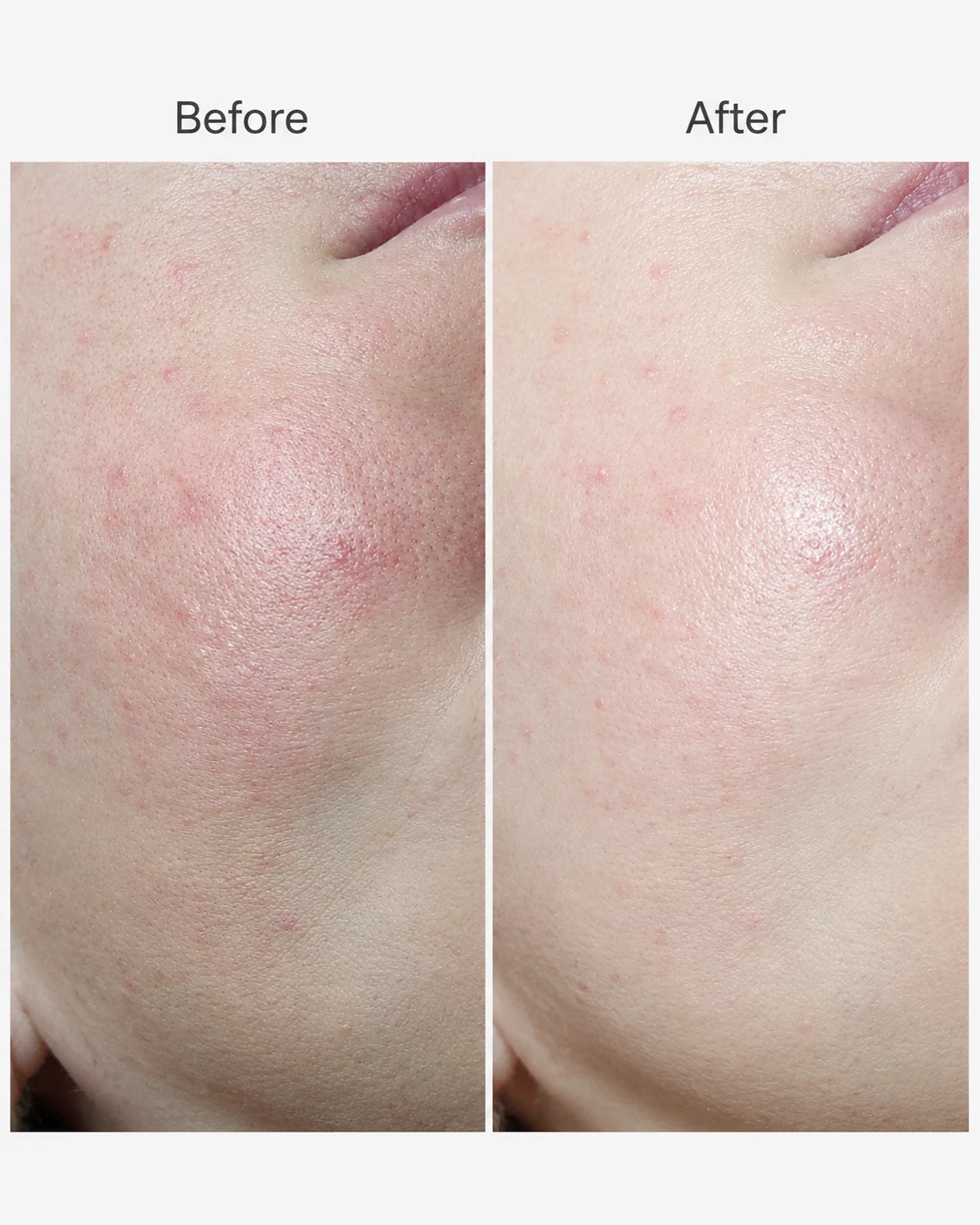
Recently, I worked with a client whose skin showed exactly this combination. Her pores were visibly enlarged and her skin produced noticeable oil, especially through the center of the face. At the same time, her cheeks and jawline showed redness, uneven texture, and several small yellow-tipped bumps.
Instead of focusing only on removing oil, I chose a calming, lightweight facial routine with panthenol.
Oily Skin Can Still Need Hydration
Excess oil does not always mean the skin has enough water.
When the skin feels stripped or uncomfortable, using harsh cleansers, frequent exfoliation, or heavy oil-control products may sometimes make it feel even more stressed.
For this client, my goal was not to make the skin feel completely oil-free. I wanted to cleanse gently while supporting hydration and helping the skin feel calmer.
This is an important distinction.
Oil and hydration are not the same thing.
Why I Chose Panthenol for Oily Skin
Panthenol, also known as provitamin B5, is a water-soluble humectant commonly used in skincare products designed to support hydration and comfort.
For oily skin, however, the formulation matters just as much as the ingredient itself.
A rich ointment or very heavy cream may feel uncomfortable on skin that already produces a significant amount of oil. For this reason, I often prefer panthenol in lightweight forms such as:
- Water-based toners
- Lightweight serums
- Ampoules
- Gel creams
- Light moisturizing lotions
During this facial, I used a lightweight panthenol-based product rather than a heavy moisturizer.
The skin still received hydration, but without creating the heavy, coated feeling that many oily-skin clients dislike.
A Minimal Routine Can Be Better
When skin looks oily, red, and sensitive at the same time, I do not believe that adding more and more products is always the answer.
A simple routine may be more comfortable:
Gentle cleansing → lightweight panthenol serum or ampoule → light moisturizer
The goal is to cleanse without aggressively stripping the skin and then replace hydration with lightweight products.
After the facial session, my client’s skin appeared calmer and more comfortable. This does not mean that one facial can treat or cure acne or another skin condition. It simply shows why observing the entire condition of the skin—not only its oil production—is so important.
An Esthetician’s Perspective
One of the biggest lessons I have learned from working with real skin is that labels such as “oily,” “dry,” or “combination” do not tell the whole story.
A client can have large pores and significant oil production while still showing visible signs of dehydration and sensitivity.
That is why I look at the skin in front of me rather than automatically choosing the strongest oil-control products.
Sometimes oily skin does not need more stripping.
Sometimes it needs gentler cleansing, lightweight hydration, and a simpler routine.
If your skin feels irritated or compromised, you may also find my guide to skin barrier repair helpful.
And for the right client and the right formulation, panthenol can be a very useful part of that routine.
This article is for cosmetic skincare education only and is not intended to diagnose or treat a medical skin condition. Persistent, painful, severe, or worsening skin concerns should be evaluated by a dermatologist or other qualified healthcare professional.
Why Oily Skin Can Become Dehydrated
One of the most common misunderstandings I see in skincare is the belief that oily skin does not need hydration.
Oil refers to sebum, while hydration refers to water content in the skin. These are not the same thing.
A person can have visible oil on the forehead, nose, and cheeks while still having skin that feels tight, rough, or uncomfortable after cleansing. In some cases, the skin may look shiny on the surface but still feel dehydrated underneath.
This can happen when the skincare routine is too aggressive.
Strong cleansers, frequent exfoliation, alcohol-heavy products, or repeated attempts to “dry out” the skin may leave it feeling stripped. When that happens, the skin may become more reactive and uncomfortable.
This is why I often remind oily-skin clients that the goal is not to remove every trace of oil.
The goal is balance.
Enlarged Pores Do Not Always Mean You Need Stronger Products
My recent client had visibly enlarged pores and noticeable oil production. It would have been easy to choose a stronger degreasing routine simply because of those characteristics.
But skin should never be judged by one feature alone.
Large-looking pores can be influenced by several factors, including oil production, skin texture, congestion, and loss of elasticity. Aggressive scrubbing or over-exfoliating will not permanently “close” pores.
In fact, when the surrounding skin becomes irritated or dehydrated, texture may appear even more noticeable.
That is why I prefer to first calm the skin and support hydration before deciding whether stronger exfoliation is appropriate.
For this particular facial, the skin’s visible redness and sensitivity were more important to me than trying to create an instantly matte finish.
What Panthenol Actually Does in Skincare
Panthenol is also known as provitamin B5.
In cosmetic skincare, it is valued because it works as a humectant, helping attract and retain moisture in the skin. It is also widely used in products designed for skin comfort and barrier support.
This makes it especially useful when the skin feels dry, tight, or easily irritated.
For oily skin, panthenol can be a useful ingredient because it does not automatically require a rich or greasy formula.
The same ingredient may appear in many different product types.
A panthenol ointment can feel very heavy.
A panthenol serum can feel almost weightless.
That is why I always look at the full formulation, not only the ingredient name on the front of the bottle.
Why Formulation Matters So Much
When I recommend panthenol for oily skin, I usually look for lightweight textures.
Panthenol for oily skin works best when it is delivered in a lightweight serum, ampoule, or gel-based formula.
A watery toner, ampoule, serum, or gel moisturizer can provide hydration without leaving the skin feeling coated.
This is particularly important for clients who dislike rich creams or who tend to feel greasy quickly.
For oily or combination skin, I generally prefer formulas that absorb easily and layer well under sunscreen during the day.
The percentage of panthenol can also vary from product to product. Higher percentages are not automatically better for every person.
A well-formulated product with a comfortable texture may be more useful than choosing a product only because the label advertises a very high percentage.
Skincare should always be about how the entire formula works on the individual skin.
A Simple Home Routine for Oily, Sensitive Skin
When oily skin also looks irritated or dehydrated, I usually prefer a simple routine rather than a complicated one.
Morning
Start with a gentle cleanser if needed.
Some people with oily skin feel comfortable cleansing in the morning, while others may only need a light rinse depending on their skin and nighttime routine.
Next, apply a lightweight hydrating toner or serum.
A panthenol serum or ampoule can be used at this step.
Follow with a light moisturizer if needed, and always finish with sunscreen.
Evening
Use a gentle cleanser to remove sunscreen, makeup, oil, and daily buildup.
Avoid scrubbing aggressively.
Apply a lightweight panthenol or hydrating serum.
Then use a simple moisturizer that feels comfortable on the skin.
If the skin is especially sensitive, this may not be the best time to add several strong active ingredients at once.
Keeping the routine simple for a period of time can make it easier to observe how the skin responds.
Ingredients That Can Pair Well With Panthenol
Panthenol works well in many simple skincare routines.
It is often combined with ingredients such as:
- Hyaluronic acid
- Glycerin
- Ceramides
- Niacinamide
- Centella asiatica
- Beta-glucan
- Allantoin
These ingredients can serve different purposes, but many are commonly found in products designed for hydration, comfort, and barrier support.
For oily skin, I would still pay attention to texture.
A formula with excellent ingredients may not be the best choice if it feels too rich or occlusive for the person using it.
When to Be Careful With Exfoliation
When someone sees enlarged pores, uneven texture, or small bumps, the first instinct is often to exfoliate more.
But more exfoliation is not always better.
AHA, BHA, and other exfoliating ingredients can be useful in the right routine, but using too many strong products too frequently may leave the skin feeling sensitive.
If the skin already looks red or uncomfortable, I often prefer to simplify the routine first.
Once the skin feels more stable, exfoliation can be considered more carefully depending on the person’s needs.
This is especially important because oily skin can tolerate some active ingredients very well while still becoming irritated if too many are layered together.
What I Observed After the Facial
After the facial, my client’s skin appeared more comfortable and less visibly flushed.
The goal was not to “cure” acne, eliminate pores, or completely transform the skin in one session.
A single facial should not be presented as a medical treatment.
Instead, the session demonstrated something I see often in professional skincare:
When skin looks oily and irritated at the same time, adding more aggressive oil control is not always the answer.
Gentle cleansing and lightweight hydration can sometimes help the skin look calmer and feel more balanced immediately after a facial.
Long-term improvement depends much more on consistent home care and avoiding unnecessary irritation.
Common Mistakes With Oily Skin
There are a few mistakes I see repeatedly.
Using a cleanser that leaves the skin feeling extremely tight is one of them.
Skipping moisturizer completely is another.
Using multiple exfoliating products at the same time can also create unnecessary irritation.
And perhaps the biggest mistake is assuming that every shiny area of the face needs to be dried out.
Healthy-looking oily skin should still feel comfortable.
If the skin feels tight, stings easily, flakes, or becomes increasingly red, the routine may need to be simplified.
Final Thoughts
Oily skin does not always need stronger cleansing.
It does not always need more exfoliation.
And it does not always need to be completely matte.
Sometimes it needs a more thoughtful balance between cleansing, hydration, and barrier support.
Panthenol can be a useful ingredient for oily skin, especially when it is used in a lightweight formulation such as a serum, ampoule, toner, or gel cream.
The facial I performed recently was a good reminder of why I never treat skin based on one label alone.
Large pores and oil production were clearly visible, but so were redness and signs of sensitivity.
For me, the best skincare approach is always to observe what the skin is showing in that moment and choose products accordingly.
That is the difference between simply following a skin-type label and truly paying attention to the skin in front of you.
Leave a Reply