
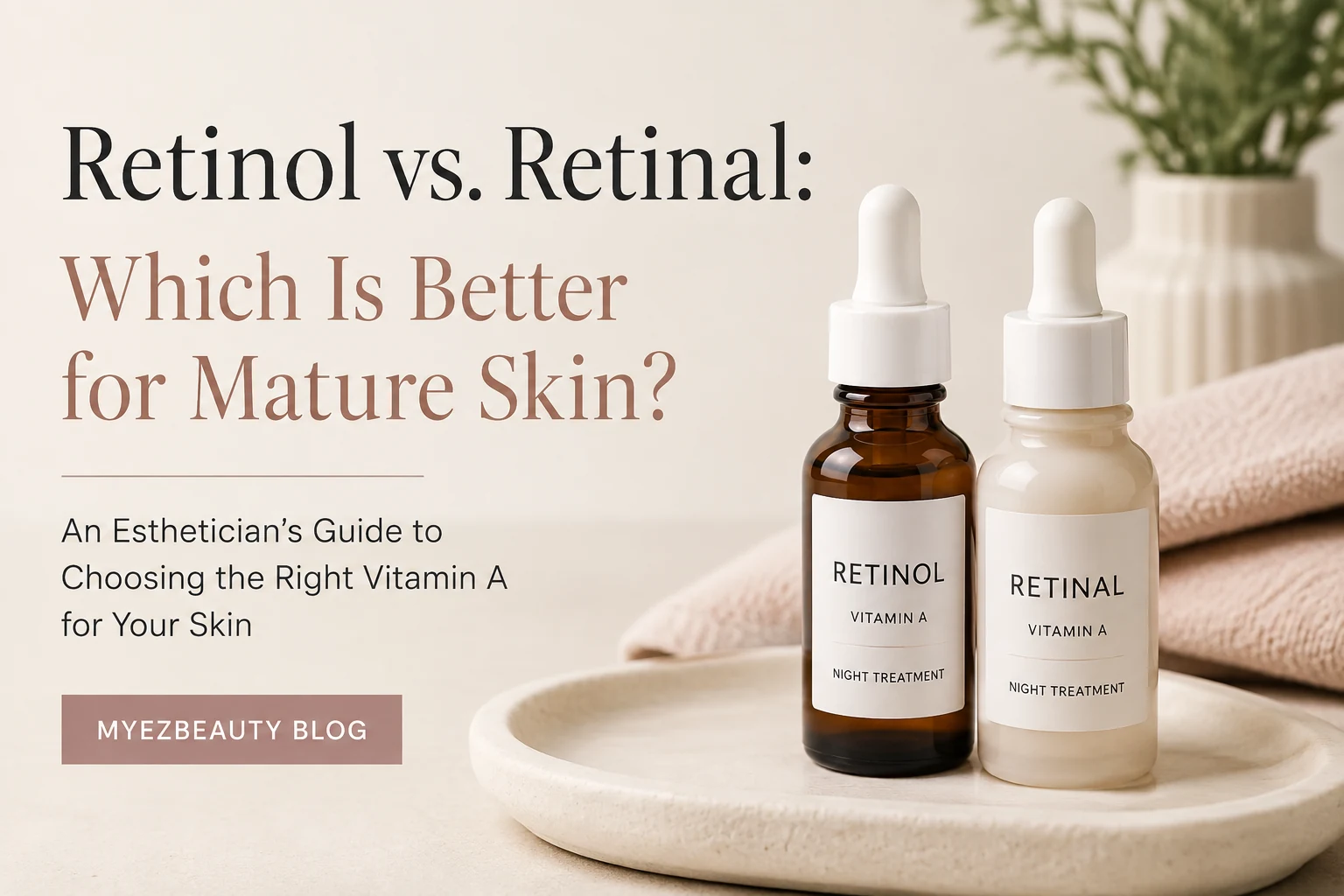
If you are trying to decide between retinol vs retinal, the difference can feel surprisingly confusing—especially when both are promoted for smoother texture, brighter-looking skin, and visible signs of aging.
As a licensed esthetician, I believe the best skincare ingredient is not simply the strongest one. For mature skin, the better choice is the one your skin can use consistently while maintaining a healthy, comfortable skin barrier.
Retinol and retinal are both vitamin A derivatives, but they work at different speeds and may feel different on the skin. Understanding how they compare can help you choose a product that fits your skin type, experience level, and overall skincare routine.
In this guide, we’ll look at retinol vs retinal, how each one works, their benefits for mature skin, how to introduce them gradually, and how to build a supportive evening routine without overwhelming your skin.
When comparing retinol vs retinal for mature skin, the goal is to balance visible results with skin comfort and barrier support.
What Is the Difference Between Retinol and Retinal?
Retinol and retinal—also called retinaldehyde—belong to the retinoid family of vitamin A derivatives. Both are commonly used in cosmetic skincare to improve the appearance of fine lines, uneven texture, dullness, and discoloration.
The main difference is how many conversion steps each ingredient needs before the skin can use it in its active form.
Retinol
Retinol must go through two conversion steps:
Retinol → Retinal → Retinoic Acid
Because of these additional steps, retinol generally works more gradually. This can make it a practical starting point for people who are new to vitamin A skincare or who prefer a slower introduction.
Retinal
Retinal is already one step closer to retinoic acid:
Retinal → Retinoic Acid
For this reason, retinal is often considered more potent than retinol at comparable cosmetic concentrations and may produce visible results more quickly.
However, stronger or faster does not automatically mean better. For mature skin, the condition of the skin barrier, sensitivity level, and consistency of use are just as important as potency.
Esthetician Tip: If your skin becomes persistently dry, tight, flaky, or uncomfortable, reducing frequency is often more helpful than trying to push through irritation.
Retinol vs. Retinal for Mature Skin: Which One Is Better?
For mature skin, the better choice depends less on age alone and more on skin tolerance, current routine, and previous experience with vitamin A products.
Retinol may be a better starting point if your skin is dry, sensitive, or completely new to retinoids. Because it works more gradually, it can be easier to introduce into a routine without causing excessive dryness or flaking.
Retinal may be a good option for someone who has already used retinol comfortably and wants to take the next step. Since retinal requires fewer conversion steps, it can offer a stronger cosmetic approach while still being available in over-the-counter skincare products.
Choose Retinol If You:
- Are new to vitamin A skincare
- Have dry or easily irritated skin
- Prefer to introduce active ingredients slowly
- Want a gentle, long-term approach to visible signs of aging
Consider Retinal If You:
- Already tolerate retinol well
- Want a more advanced vitamin A product
- Are concerned about fine lines, uneven texture, or dull-looking skin
- Can maintain a consistent moisturizing and sunscreen routine
From an esthetician’s perspective, consistency is more important than choosing the strongest formula. A gentler retinol product used comfortably and consistently may be more beneficial than a stronger retinal product that leaves your skin irritated and forces you to stop using it.
For mature skin especially, supporting the skin barrier should remain part of the routine. Hydration, moisturizer, and daily sun protection work alongside retinoids to help keep the skin looking healthy and resilient.
Benefits of Retinol and Retinal for Mature Skin
Both retinol and retinal can be valuable additions to a mature skincare routine because they support several visible concerns that often become more noticeable with age.
1. Helps Improve the Look of Fine Lines
With consistent use, vitamin A derivatives can help skin look smoother and more refined. The goal is not to erase every line, but to support a healthier-looking texture over time.
2. Supports Smoother Skin Texture
Mature skin can sometimes appear rough or uneven. Retinol and retinal encourage a more refined surface appearance, which may help the skin look softer and more polished.
3. Helps Brighten Dull-Looking Skin
As skin changes with age, it may begin to look less radiant. Retinoids can help improve the appearance of dullness and support a fresher, more even-looking complexion.
4. Helps Improve the Appearance of Uneven Skin Tone
Retinol and retinal are often used in routines designed to address the look of uneven tone and visible discoloration. They work best as part of a complete routine that also includes gentle skincare and daily sun protection.
5. Supports a More Refined Overall Appearance
Over time, consistent use may help mature skin look smoother, brighter, and more even. However, results depend heavily on how well the skin tolerates the product and whether the routine can be maintained consistently.
Esthetician Insight: Mature skin often responds better to a balanced routine than an aggressive one. Retinol or retinal should support the skin—not leave it constantly irritated, peeling, or uncomfortable.
How to Start Retinol or Retinal Without Irritating Your Skin
When introducing retinol or retinal, starting slowly is one of the best ways to protect your skin barrier and improve long-term tolerance.
Start With 1–2 Nights Per Week
Do not begin by using a retinoid every night. Start with one or two evenings per week and give your skin time to adjust.
If your skin remains comfortable after several weeks, you can gradually increase the frequency.
Use a Small Amount
A pea-sized amount is generally enough for the entire face. Using more product does not necessarily produce faster results, but it may increase dryness or irritation.
Apply to Dry Skin
After cleansing, allow your skin to dry before applying retinol or retinal. Applying a retinoid to damp skin can sometimes increase penetration and make irritation more likely.
Follow With Moisturizer
A gentle moisturizer can help support the skin barrier and reduce dryness. If your skin is especially sensitive, you can also try the “sandwich method”:
Moisturizer → Retinol or Retinal → Moisturizer
Avoid Too Many Strong Actives at Once
When first introducing a retinoid, keep the rest of your evening routine simple. Using exfoliating acids, scrubs, or several strong active ingredients at the same time may make it harder for your skin to adjust.
Esthetician Tip: If your skin feels persistently burning, painful, excessively dry, or unusually irritated, stop using the product and allow your skin barrier to recover. Persistent or concerning reactions should be evaluated by a dermatologist or another qualified medical professional.
The Best Evening Routine With Retinol or Retinal
A good retinoid routine does not need to be complicated. In fact, mature skin often benefits from keeping the evening routine simple and supportive.
Step 1: Gentle Cleanser
Start with a mild cleanser that removes makeup, sunscreen, and daily buildup without leaving the skin feeling tight or stripped.
Step 2: Hydrating Serum
If your skin needs extra hydration, apply a simple hydrating serum with ingredients such as hyaluronic acid. Avoid layering too many active ingredients when you are still adjusting to retinol or retinal.
Step 3: Retinol or Retinal
Apply a small, pea-sized amount to dry skin. Avoid the immediate eye area, corners of the nose, and lips if those areas are easily irritated.
Step 4: Moisturizer
Finish with a moisturizer that supports the skin barrier. Ingredients such as ceramides, glycerin, and hyaluronic acid can be especially helpful for mature or dry skin.
Step 5: Sunscreen the Next Morning
Daily sunscreen is essential when using a retinoid. Apply a broad-spectrum sunscreen every morning, even if most of your retinol or retinal use happens at night.
Esthetician Insight: A successful retinoid routine is not about adding more products. It is about creating the right balance between active ingredients, hydration, barrier support, and daily sun protection.
What Ingredients Can You Use With Retinol or Retinal?
Retinol and retinal can work well with several supportive skincare ingredients. The key is choosing products that help maintain hydration and comfort instead of creating an overly aggressive routine.
Hyaluronic Acid
Hyaluronic acid is a hydrating ingredient that can help the skin feel more comfortable while using a retinoid. It is especially useful for mature or dry skin that may need additional moisture support.
Ceramides
Ceramides help support the skin barrier and can be particularly helpful if retinol or retinal leaves your skin feeling dry or tight.
A ceramide-rich moisturizer is often a good finishing step in an evening retinoid routine.
Niacinamide
Niacinamide can complement a retinoid routine by supporting the appearance of a more even skin tone and a healthy skin barrier.
If your skin is sensitive, introduce new active ingredients gradually rather than starting several products at the same time.
Peptides
Peptides can also fit comfortably into many mature skincare routines. They are often paired with hydrating and barrier-supporting products and can be used on nights when you use a retinoid or on alternate evenings.
Ingredients to Use More Carefully
Exfoliating acids such as AHAs and BHAs can be useful skincare ingredients, but combining them with retinol or retinal too aggressively may increase dryness and irritation.
When you are first starting a retinoid, it is usually better to keep exfoliation on separate nights and observe how your skin responds.
Esthetician Tip: You do not need every active ingredient in the same routine. For mature skin, a simple and consistent routine often provides better results than repeatedly stressing the skin with too many strong products.
Retinol vs. Retinal — Common Mistakes to Avoid
Even a well-formulated retinoid can cause problems if it is used too aggressively. Avoiding a few common mistakes can make the routine much easier to maintain.
Using It Too Often Too Soon
One of the most common mistakes is starting with nightly use. More frequent application does not always mean faster or better results.
Begin slowly and increase only when your skin is comfortable.
Applying Too Much Product
A pea-sized amount is usually enough for the entire face. Applying extra product may increase dryness, peeling, or irritation without improving results.
Combining Too Many Strong Actives
Using retinol or retinal together with exfoliating acids, strong scrubs, or several active treatments in the same routine can overwhelm the skin.
When in doubt, simplify.
Ignoring the Skin Barrier
If the skin begins to feel tight, rough, unusually sensitive, or persistently dry, it may be a sign that your routine needs to be adjusted.
Hydration, ceramides, and a gentle moisturizer can help support barrier comfort.
Skipping Sunscreen
A retinoid routine should always be paired with consistent daytime sun protection. Skipping sunscreen can work against your skincare goals, especially if you are concerned about visible signs of aging or uneven skin tone.
Esthetician Insight: The goal is not to tolerate as much retinol or retinal as possible. The goal is to find a routine your skin can maintain comfortably and consistently over time.
How Long Does It Take to See Results?
Retinol and retinal are not overnight treatments. Visible changes usually require consistent use over time, and the timeline can vary depending on the product strength, frequency of use, skin type, and overall routine.
Some people may first notice that their skin feels smoother or looks more refined. Improvements in the appearance of fine lines, uneven texture, or discoloration generally take longer.
For mature skin, patience is especially important. Increasing the strength too quickly can lead to irritation, which may interrupt your routine and slow your overall progress.
Focus on Consistency, Not Speed
A product that your skin can comfortably use for several months is often more practical than a stronger formula that causes repeated dryness or peeling.
It can also help to take a photo before starting and compare your skin every few weeks under similar lighting. Small changes are often easier to notice over time than from one day to the next.
Esthetician Tip: Think of retinol or retinal as part of a long-term skincare routine rather than a quick fix. Consistent use, barrier support, moisturizer, and daily sunscreen all work together.
Frequently Asked Questions About Retinol vs. Retinal
Is Retinal Stronger Than Retinol?
Retinal is generally considered more potent than retinol because it requires one fewer conversion step before becoming retinoic acid in the skin.
However, stronger does not always mean better. Your skin’s tolerance and consistency of use are more important than choosing the most powerful formula.
Is Retinol or Retinal Better for Beginners?
For many beginners, retinol can be an easier place to start because it tends to work more gradually.
If you have sensitive or very dry skin, begin slowly and focus on hydration and barrier support while your skin adjusts.
Can You Use Retinol or Retinal Every Night?
Some people eventually tolerate frequent use, but it is usually better to begin with one or two nights per week.
Gradually increase frequency only if your skin remains comfortable.
Can You Use Retinol or Retinal Around the Eyes?
The eye area is delicate and may become irritated more easily. If you want to use a vitamin A product near the eyes, choose one specifically formulated for that area and follow the product directions carefully.
Do You Need Sunscreen When Using Retinol or Retinal?
Yes. Daily broad-spectrum sun protection should be an essential part of any routine that includes retinol or retinal.
Sunscreen also helps protect the results you are trying to achieve, especially when your concerns include uneven tone, dark spots, and visible signs of aging.
Final Thoughts
Understanding retinol vs retinal can help you choose a vitamin A product that fits your skin’s needs and your long-term skincare routine.
When comparing retinol vs retinal, there is no single answer that is best for everyone.
Retinol may be the better choice if you are new to vitamin A skincare, have dry or sensitive skin, or prefer a slower and gentler approach. Retinal may be a good next step if your skin already tolerates retinol well and you are looking for a more advanced option.
For mature skin, I recommend focusing less on strength and more on consistency, hydration, skin barrier support, and daily sunscreen.
A well-balanced routine that your skin can tolerate comfortably is far more valuable than using a stronger product that causes repeated irritation.
As an esthetician, I always encourage clients to pay attention to how their skin responds and adjust their routine accordingly. Skincare should support healthy-looking skin—not constantly challenge it.
If you experience persistent burning, severe irritation, swelling, or other concerning reactions, stop using the product and consult a dermatologist or other qualified medical professional.
Leave a Reply