
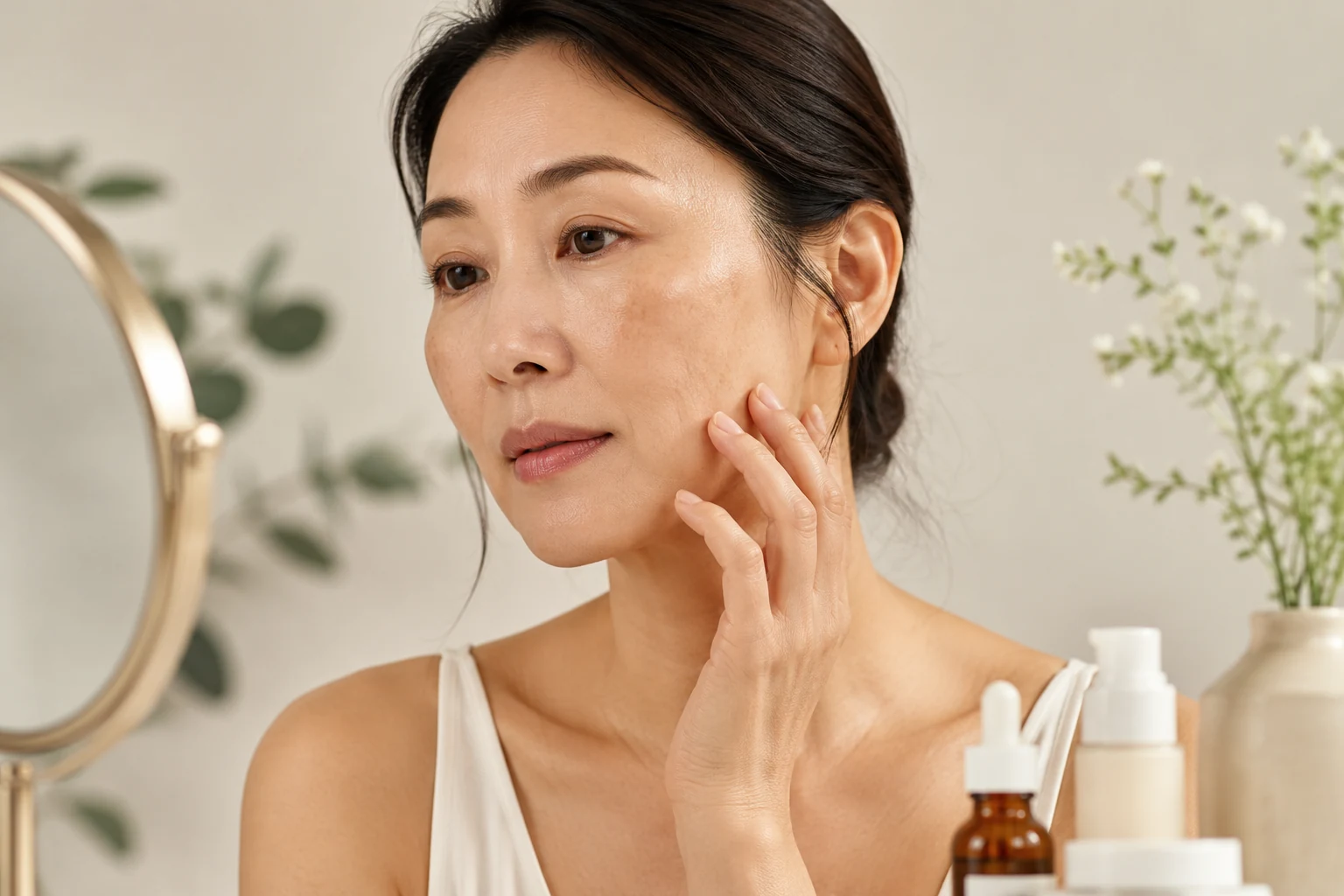
If you’ve been wondering how to fade dark spots, the first thing to know is that brighter, more even-looking skin usually comes from consistency—not from using the strongest product you can find.
Dark spots and uneven pigmentation can become more noticeable after sun exposure, blemishes, irritation, or other changes in the skin. And while it can be tempting to reach for aggressive exfoliants or multiple brightening products at once, doing too much can leave the skin feeling irritated and may make your skincare journey more difficult.
In my experience as an esthetician, I prefer a gentler and more balanced approach: protect the skin from daily sun exposure, support a healthy skin barrier, and introduce well-chosen skincare ingredients gradually.
Ingredients such as vitamin C, niacinamide, azelaic acid, and retinoids are commonly used in skincare routines designed to improve the visible appearance of dark spots and uneven skin tone. But the right routine depends on your skin type, sensitivity, and how well your skin tolerates active ingredients.
Most importantly, sunscreen should be part of the plan from the beginning. Sun exposure can contribute to existing pigmentation appearing darker, which is why consistent sun protection is one of the most important steps in maintaining a more even-looking complexion.
In this guide, I’ll explain how I approach dark spots from an esthetician’s skincare perspective—what may help, what to avoid, and how to build a routine that supports brighter-looking skin without unnecessarily compromising your skin barrier.
What Are Dark Spots and Hyperpigmentation?
Hyperpigmentation is a general term used to describe areas of the skin that appear darker than the surrounding skin.
This happens when certain areas of the skin contain more visible pigment, or melanin, than others. On the face, these darker areas may appear as small spots, patches, or an overall uneven-looking skin tone.
From an esthetician’s perspective, one of the most important things to remember is that not every dark spot has the same cause. That is why a gentle, thoughtful skincare routine is often more effective than trying to fade every type of discoloration with the same strong product.
Common Reasons Dark Spots May Appear
Some of the most common factors that can contribute to visible discoloration include:
- Sun exposure: UV exposure can make existing pigmentation appear darker and more noticeable over time.
- Blemishes: After a breakout has healed, a darker mark may remain temporarily. This is often referred to as post-inflammatory hyperpigmentation.
- Skin irritation: Picking, rubbing, over-exfoliating, or using products that are too harsh can sometimes leave the skin looking uneven.
- Natural changes in the skin: As skin changes with age, sun spots and areas of uneven pigmentation may become more visible.
- Hormonal influences: Some forms of pigmentation may be influenced by hormonal changes and should be approached carefully, especially when the cause is unclear.
The goal of cosmetic skincare is not to “erase” the skin’s natural pigment. Instead, a well-designed routine can help support a clearer, brighter, and more even-looking complexion while protecting the skin barrier.
Why Dark Spots Can Take Time to Fade
One of the biggest frustrations I hear about dark spots is that they rarely disappear overnight.
Skin renewal takes time, and visible discoloration can gradually become less noticeable as the skin goes through its natural renewal process. This is why consistency is usually more important than intensity.
Using multiple strong products at the same time may seem like a faster solution, but irritation can actually make uneven-looking pigmentation more difficult to manage.
For most people, I prefer a steady approach: protect the skin during the day, use targeted ingredients carefully, and give the skin enough time to respond.
Why Sun Protection Is the First Step in Fading Dark Spots
If your goal is to improve the appearance of dark spots, daily sun protection should be one of the first steps in your routine.
Sun exposure can make existing areas of discoloration appear darker and more noticeable. Learning how to fade dark spots starts with protecting the skin from daily sun exposure. Even when you are using brightening ingredients, inconsistent sunscreen use can work against the progress you are trying to make.
From an esthetician’s perspective, this is one of the most important habits to build before adding stronger active ingredients.
Why Sunscreen Matters for Uneven Skin Tone
Ultraviolet exposure can stimulate pigment production in the skin. Over time, this may contribute to sun spots, uneven-looking tone, and more noticeable areas of hyperpigmentation.
That is why I encourage clients to think of sunscreen not only as protection against sun damage, but also as an essential part of a skincare routine focused on maintaining a brighter, more even-looking complexion.
For everyday use, choose a broad-spectrum sunscreen with an SPF that fits your lifestyle and apply it generously to exposed skin.
Reapplication is especially important if you spend extended time outdoors, sweat, swim, or are exposed to strong sunlight throughout the day.
Mineral or Chemical Sunscreen?
Both mineral and chemical sunscreens can provide effective daily sun protection when they are used correctly.
The best sunscreen is usually the one you will apply consistently and comfortably every day.
If you have sensitive skin or are unsure which type may suit you best, you can also read our guide:
Mineral vs. Chemical Sunscreen: Which One Is Right for Your Skin?
The key is consistency. A brightening serum cannot do all the work if the skin is repeatedly exposed to unprotected UV radiation.
Don’t Forget These Areas
When applying sunscreen, people often focus only on the center of the face.
Try not to forget:
- the hairline
- temples
- ears
- jawline
- neck
- upper chest
- backs of the hands
These areas receive regular sun exposure and can also develop visible uneven pigmentation over time.
For anyone wondering how to fade dark spots, sunscreen may not feel like the most exciting step—but it is one of the most important foundations of the entire routine.
Best Skincare Ingredients for the Appearance of Dark Spots
When it comes to uneven skin tone, the goal is not to use every brightening ingredient at once.
A better approach is to choose one or two well-tolerated ingredients, use them consistently, and pay attention to how your skin responds.
From an esthetician’s perspective, I usually prefer a routine that improves the appearance of discoloration while also respecting the skin barrier.
Vitamin C
Vitamin C is one of the most popular ingredients in brightening skincare routines.
It is commonly used to help support a brighter-looking complexion and improve the visible appearance of uneven skin tone. It also provides antioxidant support, which makes it especially useful in a morning routine.
Vitamin C is often applied after cleansing and before moisturizer and sunscreen.
However, stronger formulas are not always better. If your skin is sensitive, begin with a gentler formula and introduce it gradually.
Consistency matters much more than choosing the highest percentage available.
Niacinamide
Niacinamide is a form of vitamin B3 that works well in many skin types.
It is especially useful because it can support the skin barrier while also helping the complexion appear more balanced and even.
For people who are sensitive to stronger brightening ingredients, niacinamide can be a good place to start.
It is also easy to incorporate into a routine because it is commonly found in serums, moisturizers, and other hydrating products.
One of the reasons I like niacinamide from an esthetician’s perspective is that it allows us to focus on both skin tone and skin barrier support at the same time.
Azelaic Acid
Azelaic acid is another ingredient commonly found in skincare routines designed to improve the appearance of uneven tone and post-blemish marks.
Depending on the product and concentration, it may be available in cosmetic or medical-strength formulations, so it is important to follow product directions carefully.
For everyday cosmetic skincare, I recommend introducing azelaic acid gradually rather than combining it immediately with multiple strong exfoliating or renewing ingredients.
If your skin becomes persistently irritated, uncomfortable, or unusually reactive, discontinue the product and seek professional guidance.
The purpose of a good brightening routine is not to force the skin to change quickly. It is to support gradual improvement while keeping the skin comfortable and resilient.
Do You Need All Three?
Not necessarily.
A simple routine may include:
- Vitamin C in the morning
- Niacinamide for additional barrier and tone support
- Azelaic acid introduced gradually if appropriate for your skin
But there is no need to layer every active ingredient at the same time.
If you are new to brightening skincare, start slowly. Give each product enough time to see how your skin responds before adding another.
The more complicated the routine becomes, the harder it can be to identify which product is helping—and which one may be causing irritation.
Retinoids and Gentle Exfoliation: More Is Not Always Better
When dark spots are stubborn, it can be tempting to use stronger products or exfoliate more often.
But this is where many skincare routines go wrong.
From an esthetician’s perspective, irritation is one of the biggest things I try to avoid when working toward a brighter, more even-looking complexion. If the skin barrier becomes compromised, the skin may feel dry, tight, sensitive, or uncomfortable—and visible discoloration can become even more difficult to manage.
Retinoids
Retinoids are vitamin A–derived ingredients commonly used in skincare routines to support skin renewal and improve the appearance of texture, fine lines, and uneven tone.
Over time, they may also help make post-blemish marks and other areas of visible discoloration appear less noticeable.
However, retinoids can be irritating, especially when they are introduced too quickly.
If you are new to retinoids, begin slowly and follow the directions for the specific product you are using.
For many people, this may mean starting only a few evenings per week rather than using the product every night.
It is also important to support the skin with a gentle cleanser, moisturizer, and consistent daytime sunscreen.
Prescription retinoids should be discussed with a qualified medical professional. As an esthetician, my role is to help clients build a supportive cosmetic skincare routine—not to prescribe or manage prescription treatments.
Gentle Exfoliation Can Help—But Be Careful
Exfoliating ingredients such as alpha hydroxy acids (AHAs) and beta hydroxy acids (BHAs) are often used to remove dull surface buildup and improve the appearance of skin texture and tone.
Used appropriately, gentle exfoliation can be a helpful part of a brightening routine.
But exfoliating every day is not necessary for most people.
One of the most common mistakes I see is combining several exfoliating products at the same time—for example, an exfoliating cleanser, an acid toner, a peeling serum, and a retinoid all in one routine.
The result may be redness, dryness, stinging, or increased sensitivity.
Signs You May Be Over-Exfoliating
Your routine may be too aggressive if you notice:
- persistent stinging or burning
- unusual redness
- tight or overly dry skin
- flaking
- increased sensitivity
- products that suddenly sting when they normally do not
If this happens, reduce or temporarily stop the stronger active products and return to a simple routine focused on cleansing, moisturizing, and sun protection.
Protect the Skin Barrier While Working on Dark Spots
A healthy-looking skin barrier should remain part of the plan even when your main goal is pigmentation.
A healthy skin barrier is an important part of learning how to fade dark spots without causing unnecessary irritation.
Ingredients such as ceramides, glycerin, hyaluronic acid, and other moisturizing ingredients can help support hydration and maintain a comfortable skin barrier.
This is why I never view brightening and barrier care as two separate goals.
They work best together.
If your skin is constantly irritated, adding another active ingredient is usually not the answer. A calmer, well-supported skin barrier gives you a better foundation for a consistent skincare routine.
For more on this topic, see our MyezBeauty guides on Skin Barrier Repair and Ceramide vs. Hyaluronic Acid.
Final Thoughts: A Gentle, Consistent Approach Works Best
If you are trying to learn how to fade dark spots, remember that brighter, more even-looking skin usually comes from patience, consistency, and a well-balanced routine.
You do not need the strongest serum, the highest concentration, or the most complicated skincare routine.
The best approach to how to fade dark spots is usually gentle, consistent skincare rather than an overly aggressive routine.
The best approach to how to fade dark spots is usually gentle, consistent skincare rather than an overly aggressive routine.
In my experience as an esthetician, the most successful routines usually begin with the basics:
- protect the skin from daily sun exposure
- support a healthy skin barrier
- choose targeted ingredients carefully
- introduce active products gradually
- avoid unnecessary irritation
- stay consistent long enough to evaluate your results
Vitamin C, niacinamide, azelaic acid, retinoids, and gentle exfoliating ingredients can each play a role in improving the visible appearance of uneven skin tone. But no single ingredient works the same way for everyone.
Your skin type, sensitivity, lifestyle, and current routine all matter.
And perhaps most importantly, never underestimate the value of sunscreen. Protecting the skin every day helps support the progress you are working so hard to achieve.
Healthy-looking skin is not about perfection.
It is about understanding your skin, respecting its limits, and choosing habits that you can maintain over time.
Esthetician’s Note
This article is intended for educational skincare purposes from an esthetician’s perspective and is not intended to diagnose, prescribe, or treat medical skin conditions.
If you notice a new or changing dark spot, persistent pigmentation, discomfort, bleeding, or any skin change that concerns you, consult a board-certified dermatologist or another qualified medical professional for appropriate evaluation.
Leave a Reply